

Photo Record
Images
Additional Images [1]
Metadata
Collection |
Keim Farmstead |
Title |
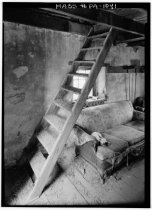
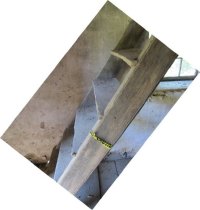
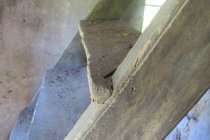
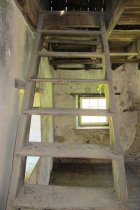
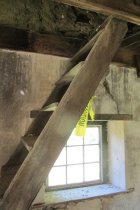
Step Ladder to Loft |
Archive Number |
KAPH9 |
Description |
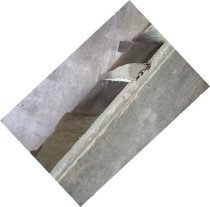
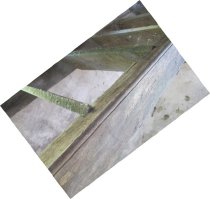
Step ladder{1} to loft, interior of Keim wood-turner's shop and multiple-purpose ["ancillary"] building: Digital photographic images showing interior detail views of step ladder. FOOTNOTE:{1} The 1786 Rule Book of the Carpenters Company of Philadelphia prescribed [p.22] a price "per foot lineal" for "Step ladders, made of boards." This ascending carriage structure is distinguished from "stairs" [also "stair"] by the absence of risers and the scribed side-board known as a "string"{2}, and from a "ladder" by the presence of "open-riser" treads ["board steps"] rather than dowel-form rungs. The term "Stairs" in the HABS caption should thus be read as "step ladder". FOOTNOTE: {2} Also "stringer" [Lounsbury, Glossary, op. cit.below]; note the fileted moulding along the outer edge of the strings in the detail photos in this record. Description: Original HABS caption for image #1: "Historic American Buildings Survey, Cervin Robinson, Photographer August, 1958 STAIRS TO ATTIC." Data sheets for HABS images (KCPH5 thru KCPH9--1002.01.031, .032, .033, .034 & .035) associated with the Keim ancillary building appear in MULTIMEDIA LINKS or see Archive record KCTX1--1002.01.037. In the mid-southern Atlantic-seaboard colonies, such ladders in "houses of poorer folks" through the Civil War era had been called "ladder stairs", as noted in a scholarly and comprehensive treatise on early architecture of the Chesapeake region: The Chesapeake House, edited by Cary Carson & Carl Lounsbury and published by Colonial Williamsburg and Univ. of North Carolina Press (2013), pp. 341-342, and illustration Fig. 14.36. The authors also note the name "ladder stair" as derived from the lack of risers and stringers slotted to receive and secure the treads or rungs. In his well-documented "Illustrated Glossary of Early Southern Architecture and Landscape", Univ. of VA Press/Oxford U. Press (1994), Carl Lounsbury, co-editor of The Chesapeake House, points out at page 346 that "Stairs are formed by a carriage containing horizontal treads and vertical risers." [Italics in original text], and defines "ladders" at p. 204 as "two side pieces"…and "rungs" or "steps", with no mention of risers. Thus, the 19th century vernacular usage "ladder stair" seems anomalous as suggesting a carriage structure both with and without risers. In addition to the economy and ease of construction of riser-less ladders, the steep plane of a ladder and the geometric relationship between contiguous treads precludes or significantly impedes the installation of vertical risers from the inner edge of a lower tread to the underside of the forward edge of the tread immediately above. Laurence Ward, June 2016; revised December, 2017, January 7, 2018, and February, 2021. |
Search Terms |
KPH KCPH KAPH KA Keim Photo Keim Cabin HABS HABS Photo Historic American Buildings Survey Library of Congress Stairs Attic Stairs Vintage Photo Carriage Step Ladder Stepladder Stair Ladder Stairs Ladder ST Tread Riser Ladder String Stringer KAPH9 |
People |
Keim, Jacob Robinson, Cervin |
Object Name |
Print, Photographic |
Accession number |
1002.01 |
Date |
August 1958 |
Photographer |
Cervin Robinson; balance of photos: Laurence F. Ward. |
Notes |
Please note HABS created three separate files for three separate buildings at the Keim Farmstead: the house, barn, and "cabin" [later determined to be a multifunction "ancillary" structure, with strong evidence of a wood-turner's shop on the level above the spring-cellar]. HABS info (images & text) on barn & "cabin" [now called an "ancillary"] has been archived under the KB (Keim Barn) and KA (Keim Ancillary) Docset prefixes. |
Catalog Number |
1002.01.034 |
Copyright |
1958, 2009 |