

Photo Record
Images
Metadata
Collection |
Mouns Jones |
Title |
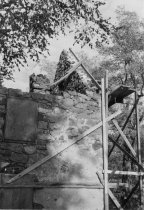
Detail of gable and eaves wall during restoration |
Archive Number |
MJHPH47 |
Description |
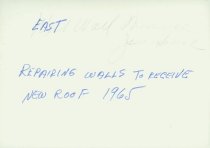
Black and white photographic print showing detail of southwest eaves wall and interior of southeast gable wall of the Mouns Jones House during 1960s restoration. Details include reconstructed and re-mortared ["mudded-in"] upper gable wall; roof-pitch aligned by temporary "rake" board{1}, and unrestored corner chimney [left quadrant of photo below tree branches]. This view is prior to "flushing-up" top of stonework below both eaves-levels, setting rafter plates and floor joists, and replacing the roof. The vertical hung-sash window frame seen here [in the south (right) bay] was later replaced with a horizontal casement window, probably based on the 1886 woodcut [MJHDWG2--1000.01.089] and photographs showing an horizontally aligned casement oriented in the north bay of the second floor to avoid conflict with the 19th century porch roof [see, e.g. MJHPH1--1000.01.001, two images]. See additional image for notes and date written in blue pen & pencil on verso. FOOTNOTE {1} The temporary rake board was in place to establish the interior angle of the gable-apex and the vertical position of the joints between the gable masonry and the intersecting eaves walls. Measurements have been taken determining that the rake boards and rafter plates are rotated from the "true" eaves-to-eaves horizontal plane. The two rafter tails at the southern gable-end are at different elevations, indicating that the 1970 replacement roof is "rotated" clockwise when viewed from the south, and that the rafters on the eastern plane of the roof are slightly longer than those on the western plane. This results in the two-board rafter plate on the river-side wall being noticeably higher than its counterpart on the opposite wall. This in turn creates a different set of load and thrust vectors imposed by the roofing materials supported and restrained by each eaves wall's rafter plates, a measure of disequilibrium which is offset marginally by the collar ties about 7 feet above the attic floor. As an additional, possibly redundant, roof-thrust stabilizer, some of the attic floor joists were attached by steel angles or brackets to the rafter plates atop each longitudinal wall of the house. The correspondingly attached joists will thus function mechanically as traditional tie-beams, reducing the lateral strain from roof-loads on each masonry wall and significantly mitigating the risk of lateral failure at eaves-level. Laurence Ward, April, 2019, May 2023 |
Search Terms |
MJPH MJHPH MJH Mouns Jones House Mouns Jones House Photo Ruins Corner Chimney Detail Photo Vintage Photo Gable Restoration Restoration Photo Rake Board Rafter plate |
People |
Jones, Mouns |
Object Name |
Print, Photographic |
Accession number |
1000.01 |
Date |
1965 |
Photographer |
Unknown |
Catalog Number |
1000.01.051 |