

Photo Record
Images
Additional Images [82]
Metadata
Collection |
DeTurk |
Title |
Fireplace Lintel and Masonry Restoration |
Archive Number |
DTR09PH138 |
Description |
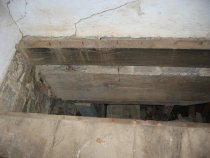
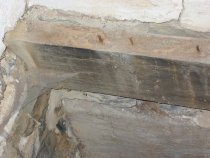
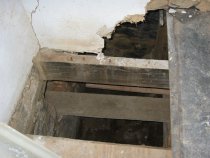
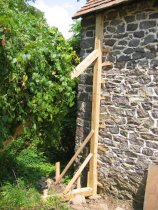
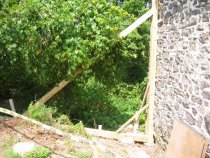
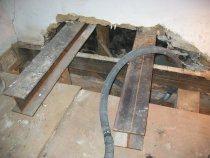
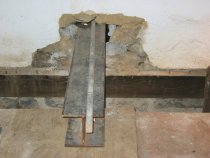
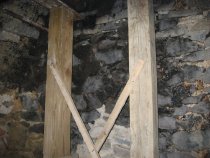
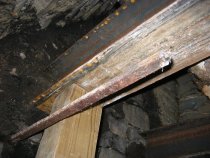
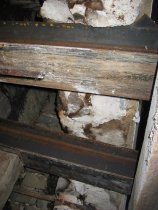
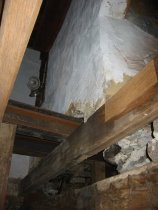
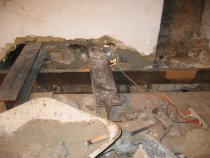
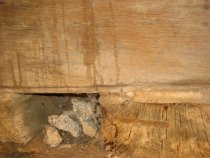
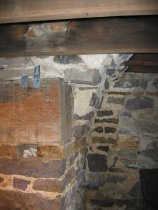
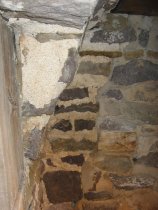
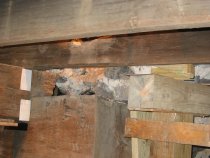
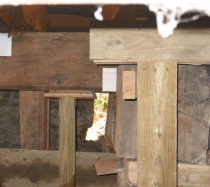
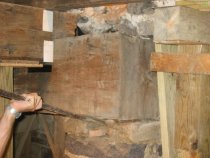
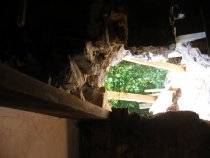
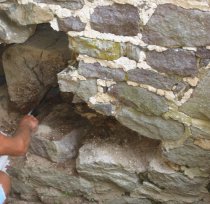
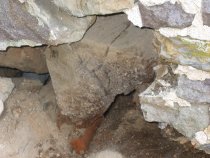
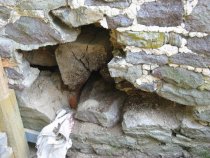
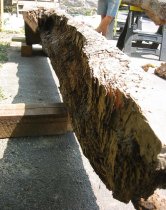
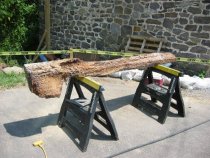
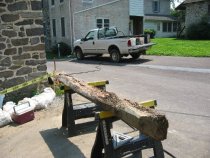
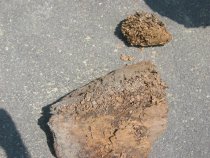
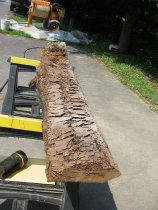
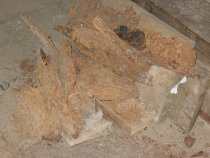
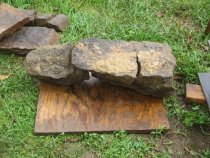
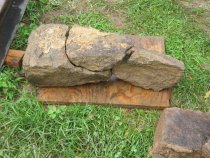
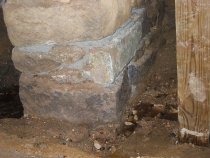
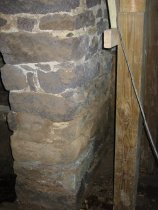
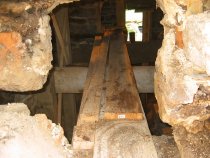
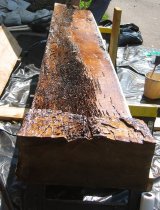
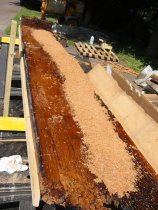
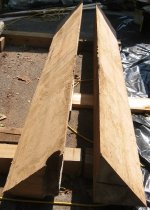
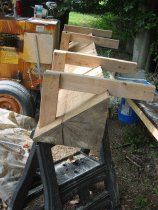
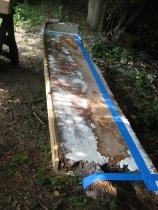
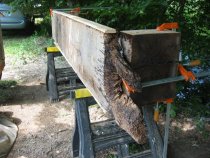
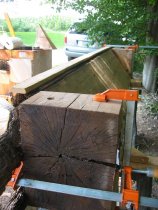
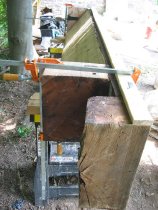
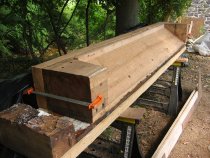
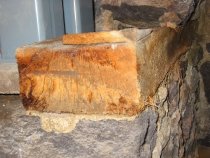
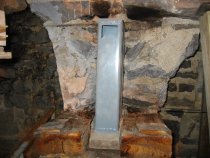
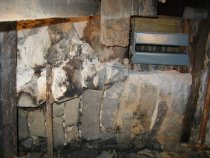
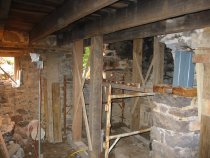
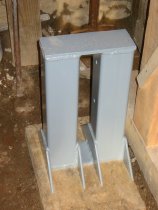
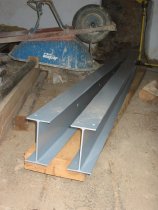
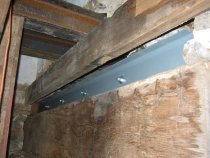
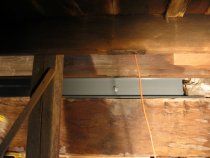
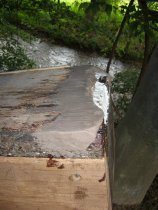
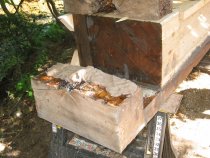
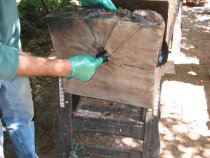
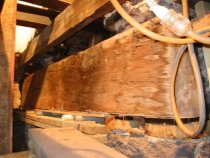
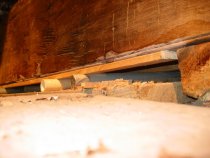
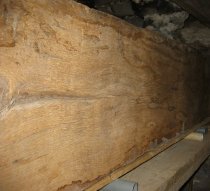
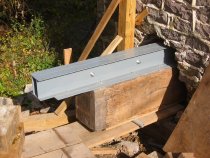
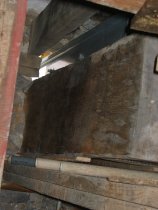
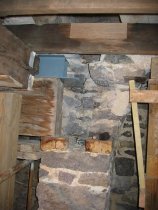
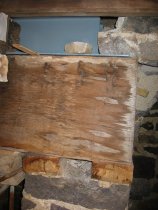
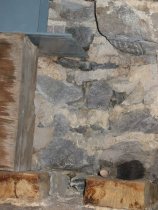
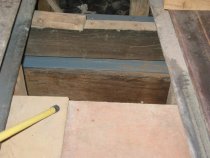
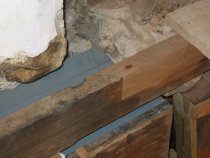
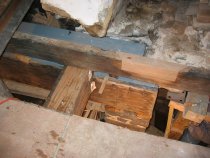
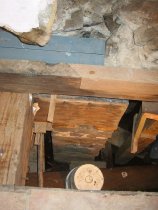
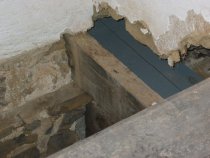
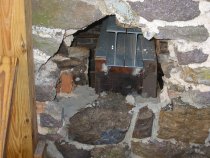
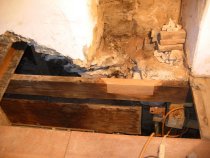
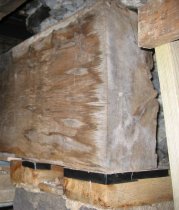
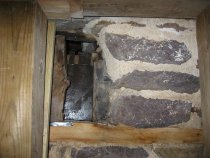
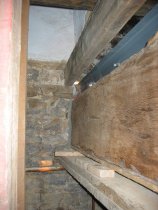
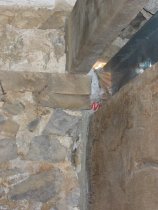
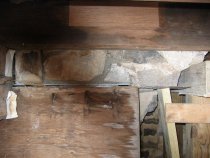
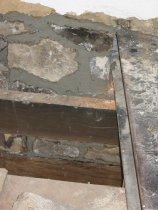
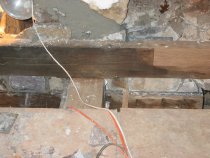
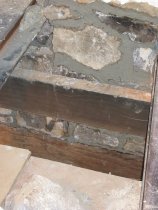
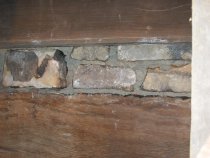
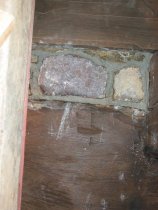
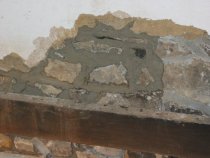
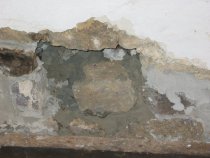
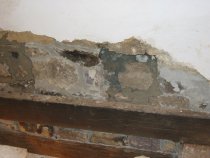
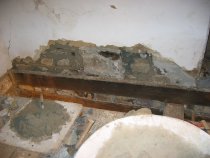
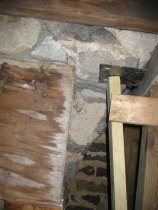
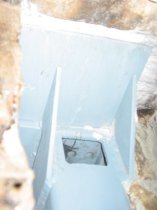
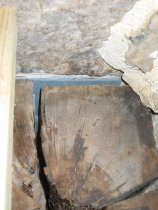
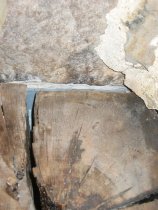
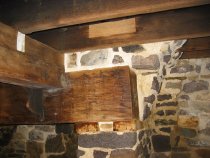
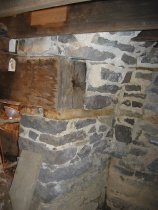
Series of 89 photographs depicting the restoration of the fireplace lintel and masonry in the DeTurk house. Detailed captions appear below. DETAILED CAPTIONS #890, 8/9/09: Fireplace lintel (the large beam, also called a "chimney-tree," "manteltree," and "balk" [early English: "baulk"] supporting the stone masonry chimney "breast") across center of photo, below joist with protruding rusty nails] seen through opening created by temporary removal of ends of first floor boards; also showing west end of lintel sheared off from bearing position in west [left] pointed masonry wall. The lintel has been borne on "temporary" posts ["shores"] [center of photo, just above second joist with protruding floor-board nails] since the 1970s, when termite damage and the resulting loss of resistance to tensile and shearing forces on the beam caused this failure. The complex forces acting on this structure included stresses caused by the degradation of the east eaves wall foundation from water incursion which dissolved the lime-binder component of the joint mortar. The sequence of failures in the east and north walls of the building is not determinable. However, the severe crack in the north gable masonry [see DTR09PH100--1001.01.192, and Atlas sheet 52] was caused by the same type and magnitude of a near-catastrophic event as that which caused the lintel’s sudden drop of several inches when the exposed "mantel" timber sheared off from the end-block resting in the masonry pocket. These destabilizing events might have occurred in a short sequence of time during a "tectonic" serial failure, causing the jagged vertical fracture in the north wall, the transverse crack in the kitchen cellar door sill, the fragmentation of the sub-floor corner stone in the fireplace pier ["jamb" or "leg"], and the shear-failure of the fireplace lintel at its recessed junction with the west masonry wall. #893: Closer west corner detail of #890. #958, same view as #890, after removal of the lintel through the opening in the west wall, and after insertion of the I-beam shore seen along the right edge of the photo. 918 & 919, 8/17/09: Timber "raking-shore" buttress against the northern section of the west eaves wall during removal, reconstruction, and replacement of fireplace lintel ["manteltree," chimney-tree"]. This temporary support structure, with a diagonal "raking" brace against the shimmed vertical post compressed against the wall, provides resistance to the thrust from the roof and gable wall, relieving some of the load component usually borne by the masonry mass and timbers of the fireplace, chimney, and eaves wall during restoration of these elements. #935, 8/18/09: Pair of steel I-beams "needled" through south wall of chimney stack to carry the masonry mass of the chimney during restoration of the fireplace lintel and the compromised east pier ["jamb" or "leg"] of the fireplace. The steel beams are supported on wooden posts set on a wooden sill ["bottom plate"] across the kitchen floor south of the fireplace [#920, 8/17/09] and on the 20th century stone-paved fireplace hearth [see photos #964 and 976 [8/19/09], and 1020, 8/25/09 (from below)]. #1224, shows the I-beams "needled" through and temporarily supporting the plastered south wall of the chimney stack ["pile"]. The plaster-coated masonry in the upper right corner is the west jamb ["cheek wall"] of the arched first floor fireplace. New wood in lower-left is the "Dutchman" repair to the charred joist below the front hearth of the fireplace. #1449, 11/5/09 shows the two I-beams supported on the first floor and its northernmost joist. The disintegrating first floor fireplace is in the upper-right corner of this photo. #931, 8/17/09: Detail of east end of lintel, with beaded lower edge ["arris"], bearing on two white oak leveling plates. The eastern [right] plate also serves as the impost for the corbel ["half-arch"] supporting the east half of the first floor fireplace hearth; the western member [also at the impost level supporting the "springer" (lowest) course of the cantilevered corbel] of this pair of timbers bears the west half of the upper fireplace and a portion of the east wall of the chimney stack ["pile"]. These two timbers do not appear to be pocketed into the north gable wall, and therefore do not serve a third function as "ties." Although deformed to the contours of the stones bearing [and bearing on] them, they have served in relatively stable compression under a load of several tons per square foot of bearing surface for over 240 years. These embedded oak plates bear on the eastern masonry pier ["jamb," or, anglicized, "leg"] of the fireplace [see #938, 8/13/09, and #957, 8/14/09, a detail of the eastern end-grain of the lintel and eastern corbel ("bracket"), which also shows the reconstructed eastern segment of the north gable wall from inside the kitchen, which repaired a long vertical crack in the 1970s]. #942, 8/18/09: Eastern end of lintel showing summer beam lap-joined to the lintel. The end-grain of the lintel is noticeably "checked" [split along the grain from shrinkage during the drying process; "checks" were called "shakes" in pre-20th century British practice], and served as the entry point for the termite colony which infested and degraded the structural integrity of this beam. The insects probably entered the summer beam through its northern end-grain, boring in from the lintel and causing the same hollowing of the structural cores of both beams [see series of photos depicting and describing the restoration and consolidation of the damaged summer beam in record DTR09PH136--1001.01.235]. #948, 8/18/09: Northern segment of east face of the chamfered summer beam on temporary shoring post [upper left quadrant of photo], showing the end-grain of fireplace lintel behind the pine post in right half of photo. The lintel has been pried upward, as shown in photo #943, 8/18/09, to insert shims and rollers on a plank platform supported on scaffolding supports to facilitate removal of lintel through the temporary opening in west eaves wall [slot of daylight in center of photo, and a closer view in #1021, 8/26/09]. A detail of this view is in #949, 8/18/09. #932, 933, & 934, 8/18/09: Removal of lintel through temporary opening in northern segment of west eaves wall, near walled-up bake oven site. This opening, buttressed by the raking-shore brace [photos 918 & 919] and temporary steel beams "needled" through the chimney breast [photo 935], remains stable during removal and restoration as a roughly formed rubble masonry "arch", transferring most of the incumbent loads bearing on it to the masonry wall segments abutting the opening. #954, 8/18/09: Lintel prior to cutting away degraded interior segments from the exposed timber portion, and end-grain block; these fragments of the original "chimney-tree" will be preserved and consolidated with re-claimed components to form a re-constructed lintel. This assembly conforms to the preservation principle which prefers conservation and re-use of as much of the original "fabric" as practicable, minimizing replication of components in the process. #938, 939, 940, 941 & 1056: Fragments of the disintegrated lintel, lacerated with termite tunnels. These pieces dramatically illustrate the cause of the loss of structural integrity of the beam and its dislodgment and deflection from the masonry pocket in the west eaves wall. #963 & 964: Stone, broken into three pieces [see opposing transverse views in photos 963 & 964, 8/14/09], removed from a sub-grade corner position in the eastern pier ["jamb", "leg"] of the kitchen fireplace. This displaced{1}and fractured stone was discovered when the fill south of the fireplace was excavated to determine the original kitchen floor level. The pier was immediately shored with posts and braces, and a replacement stone inserted into the pier in the position originally occupied by the single stone seen here in pieces. See the restored pier in #968 & 969, 8/19/09, included in this record. The three broken pieces were displaced laterally ["out-of-plumb"] to a position several inches outside the eastern plane of the pier, possibly during the same "tectonic" event or series of events causing several other small-scale failures in the northeastern segment of the kitchen masonry and framing elements. This fragmentation left only a few inches of bearing surface of the fractured stone [sometimes called a "unit" in modern engineering parlance, despite the non-uniformity of "random" rubble masonry stones, probably because of the "unit" sizes and shapes of concrete block and similar modern building components] supporting a significant portion of the mass of the chimney stack ["pile"], loads previously carried by the fireplace lintel [and now by the steel I-beam shown in photos##1224 & 1449]. #955: Exterior view of opening in north end of west eaves wall through which the lintel was removed on rollers along a plank platform. #991: Exposed face segment of lintel treated with a borate solution to retard fungus and insect infestation. #1002, 8/24/09: Face segment, salvaged from original lintel, after consolidation with sawdust saturated with borate and a binder. #992, 8/24/09: Replacement beveled smoke baffle, sawn from re-claimed ["re-cycled"] white oak timber. #1003, 8/25/09: Beveled segment of re-constructed lintel with mount-frames attached. #1004, 8/25/09: Exposed face-plank after application of wood filler, prior to assembly with replacement half-beam sawn in a 45 degree bevel to serve as a smoke baffle. #1005, 8/25/09: Mock-up I-beam [white pine and masonite] used to determine the precise dimensions and optimum location of the permanent steel beam which will be installed above the lintel to relieve it of the loads imposed by the chimney stack and related wall mass.. #1002, 8/26/09: Re-sawn oak smoke-baffle joined to two end-grain blocks salvaged from the original lintel to form a composite replacement lintel. The end-grain in the foreground, extensively checked, is the end-block of the lintel, which will be set in the west eaves wall masonry pocket. #1003, 8/26/09: East end grain block from original lintel, joined to replacement smoke-baffle to complete assembly of re-constructed composite lintel. This portion is the exposed timber on the two bearing plates shown in photo #931. #1040, 8/27/09: Reconstructed lintel, glued and bolted together; slot in left foreground is the opening inside the east end-grain block for the steel double-post which will support the I-beam above the lintel and behind the re-laid masonry chimney breast. [See #1044 for a full view of the restored lintel from the west end and #1042 for a detail view of the west end of the re-fabricated lintel]. This steel beam will be the primary bearing element of the restored chimney structure, relieving the timber lintel of much of this burden. The lintel will be borne on the west by the masonry wall pocket and on the east by the two oak leveling plates carried by the masonry pier ["jamb", "leg"] of the fireplace. #1008, 8/26/09: The white oak timber in the center of the photo [end-grain in foreground] is the eastern bearing and leveling plate for the lintel. The masonry at the top of the photo is the springer course of the corbelled "half-arch" which is carried by this plate and which supports the eastern half of the fireplace hearth on the first floor above. The blue metal posts in the upper left corner will bear the steel I-beam referred to in #1040 above. #1010, 8/26/09: Steel tandem-post set between original oak bearing plates to receive chimney stack and masonry wall loads previously borne by the timber lintel ["chimney-tree"]. The left [west] masonry corbel supports the west half of the first floor fireplace hearth and the east "pile" of the chimney stack; the eastern corbel carries the east half of the first floor fireplace hearth and a portion of the chimney mass. See discussion to #931 above. The masonry in the left third of the photo is the back wall of the fireplace, facing south. #1017, 8/26/09 shows the double-post from the west before re-installation of the lintel. The white parging in the upper segment of the photo coats the cantilevered underside of the west corbel springing from the western oak impost-plate. The large stones in the left third of the photo compose part of the east wall of the fireplace. #11036, 8/26/09: Perspective view of the lower ground level kitchen fireplace [right-center] and interior of west wall [left and center] before re-installation of lintel. The four 8" square posts [center and right], set on sills of the same dimension, support the two steel I-beams bearing the chimney mass ["pile"] and related loads during restoration of the lintel and summer beam partially borne by the lintel. The wall opening to the right is a temporary portal for removal and re-insertion of the lintel. The opening to the left is the window in the west wall of the kitchen, with a replacement frame fabricated from reclaimed and re-sawn white oak in 2009. In the upper-right quarter of the photo is the steel double-post which will bear the permanent I-beams and the steel leveling plate, which will help carry the corbelled pier at the east end of the lintel . #1210, 10/1/09 shows this double post [upside-down] with "fins" which will partially support the steel plate under the flanges of the pair of I-beams, and also partially bear the cantilevered stones in the corbelled "bracket" carrying the east half of the first floor fireplace. This set of redundant load-bearing elements will relieve the kitchen fireplace lintel of much of the loads it carried prior to this restoration campaign. Although this retrofit utilizes modern materials and techniques, a considerable portion of the original elements ["fabric"] was preserved and re-integrated into the structure. The components of an I-beam and the ability to neutralize compressive forces [on the top flange] and tensile stresses [along bottom flange] are critical to its mechanical capacity. #1011, 8/25/09: Two new steel I-beams, powder-coated for corrosion-resistance, will be bolted together and set on the dual post [#1210] and the masonry shelf in the west wall to carry the chimney and related loads previously borne by the compromised oak lintel. See details of the completed assembly, now functioning as a mechanically-assisted composite lintel, in the discussion to the series of photos from #1348 to 1369 below. #1295, 10/20/09 shows the southern member of the pair of I-beams, which is bolted through its web to the concealed second beam, and is now borne by the steel post [#1210] and the masonry pocket in the west wall, not by the lintel. The blue-coated I-beam will be concealed behind the restored masonry chimney breast. The mechanically connected pair of beams replaces the lintel as the primary bearing member for the chimney stack and contributing loads. #1288: Detail of #1295. The thin steel plate extending to the east [right] beyond the end of the steel beam supports and levels the beams, carries them to the post, and partially bears the east [right] corbelled masonry "bracket" under the eastern half of the first floor fireplace. #1058 & 1059, 9/1/09: Epoxy consolidant/adhesive applied to each end of lintel prior to bedding in the west masonry wall "pocket" and setting on the steel I-beam. #1061 shows the other half of the end-block being set in adhesive in the position seen in #1059. #1191 shows the lintel on rollers ready to be set in its original position on the two bearing plates near the lower right corner of the photo. These original oak plates are also the imposts carrying the "springer" course of the two corbelled "half-arches" ["brackets"] which support the first floor fireplace above. #1208, a detail of #1191, provides a clear view of the beaded lower edge ["arris"] of the lintel. This long bead in its prominent position over the fireplace, and the long runs of chamfering on beams, plates, outlookers, and joists in this building, exemplify the decorative details and meticulous joinery practices composing the "art and mystery" of medieval carpentry and joinery. These inherited techniques articulate, in attenuated and individualized forms, the skills and folk-artistry of 18th century rural Pennsylvania craftsmen. The western bearing plate for the lintel is in the lower-right corner of the photo. #1225, 10/05/09: Re-assembled lintel, with original face-board consolidated with the replacement smoke baffle, chamfered at a 45 degree angle, set on rollers to transport it through the temporary wall opening to original position on bearing plates and masonry bearing pocket in the west wall. #1333, 10/26/09: Restored lintel and steel I-beam on steel leveling plate being rolled into original position through temporary opening in west eaves wall. #1337: view of lintel entering on rollers, from interior. #1346: Detail of lintel resting on one of the pair of bearing and leveling plates. The steel plate projecting ["cantilevered"] beyond the lintel and I-beam will help support the corbelled stone "bracket" which carries half of the first floor fireplace. The final position of the east end-grain face of the lintel will be flush with the eastern [right in photo] oak bearing pad, as seen in #1354 showing the steel plate inserted under the corbelled stone. #1347: Detail of #1345. The underside of the large stone in the upper-right corner has been ground to a flat plane to receive the projecting steel plate which will act as a redundant support element for the corbelled masonry and the first floor fireplace above. #1348 & 1349 10/27/09 & 1372, 1373 & 1374, 10/28/09: Detail views of lintel, steel plate, and I-beam assembly from first floor. #1355 & 1356: Detail views of bolted pair of I-beams positioned on top of the lintel, but borne on the two oak plates on the east and in the masonry wall "pocket" on the west. #1369, 10/28/09: I-beams and steel plate seen through opening in west wall. The steel beams project into the wall beyond the end of the steel plate and will be supported on the re-laid masonry set in the temporary opening. The I-beams will the carry most of the chimney loads formerly carried across the fireplace by the failed oak lintel. #1212, 10/01/09: Re-installed lintel from the first floor, prior to restoring masonry chimney breast, showing partially disintegrated first floor fireplace [upper-right], long half-dovetail ["dutchman"] repair to burn-damaged original joist, and two transport-rollers on temporary scaffolding planks. Temporary eastern I-beam is at left edge. #1223 is a detail view of the east end of the lintel in final position on the bearing plates; the black tape protects the plates from the borate solution [gray residue] applied to the lintel to combat termites and other infestation. #1232 is a view from the east showing the lintel in final orientation; the recessed glossy-coated timber segment, to the right of the large masonry corbelled pier ["bracket"] in the top half of the photo, is the end-block portion of the lintel east of the chamfered smoke baffle. The steel support post will stand in the recess between the two oak bearing plates on the east pier of the fireplace. #1435, 11/02/09: Detail of the western end of the southern steel I beam above the re-set oak lintel, which has been mortared ["mudded-in"] to the bearing pocket in the west wall, after bolting the two I-beams together through their vertical webs, before removal of the planks supporting the lintel on scaffolding racks. #1436: Detail view of the western end of #1435. The joist in the upper center is borne on the stacked pair of leveling, bearing, and relieving timbers, embedded in the west wall, which have been shortened to accommodate the temporary portal through the masonry opened up to allow removal and re-placement of the lintel and I-beams. See #1442 which shows the southern ends of these plates, the upper member entering the east-west cross wall between the kitchen and root cellars. #1384, 10/30/09 and #1450, 1451, 1452, 1454, & 1455: Details of chimney breast above re-installed lintel, re-laid and freshly "mudded-in" prior to re-pointing. The eastern "needled" temporary steel I-beam appears along the right edge of #1450; the western beam is in the upper-left corner of #1452. Additional detail views of the process appear in #1493, 1494, 1495, & 1496, 11/11/09. #1387: Detail of #1384 prior to removing shimmed shoring post from under corbelled "half-arch" in upper-right quadrant of photo. The timber along the top of the photo is the northernmost first floor joist. #1394, 10/31/09: Detail of underside of post supporting I-beams showing the two "fins" welded to the post to partially support the thin steel plate inserted under the "shaved" underside of the cantilevered stone supporting the eastern half of the first floor fireplace above. #1473 & 1474, 11/8/09 are views of the split ["shaken"] eastern end of the lintel. The blue steel plate on top of the lintel supports a large cantilevered stone [with its lower face ground-down to receive the steel plate] in the half-arch corbelled bracket carrying the eastern half of the first floor fireplace. #304, 9/30/10 and 1497, 11/11/09 are SE perspective views of the restored and re-installed lintel borne by the two original 1767 white oak leveling plates; re-fabricated and re-set summer beam; "dutchman" repair to joist burned by embers from the first floor fireplace; and re-pointed masonry chimney breast re-laid on flange of steel I-beam. The stonework to the right of the wide crack in the wall segment along the right edge of the photo is the 1970s repair of the fracture indicated in the plan on Sheet #52 of the Atlas of Architectural Drawings (2008), accompanied by the notation "Wall Cracked, moved 6" +/-", indicating the lateral shift of the eastern segment of the north gable wall across the crack toward the west, slightly overriding the central bay of the wall L. Ward, 2009, updated, October, 2021 . |
Search Terms |
DTR09PH DTHPH DTR09 DT De Turck De Turk DeTurck DeTurk DeTurk House DeTurk Photo Fireplace Fireplace Lintel Masonry Structure Manteltree Balk Baulk Chimney breast Jamb Raking shore Chimney tree Needle beam Chimney pile Cheek wall Dutchman joint Arris Impost Corbel Springer Tie Summer beam Check Shake Chamfer Lintel Borate Smoke-baffle Leveling plate I-beam Epoxy Wall pocket Cantilever Half-dovetail Bracket Stacked plates |
People |
DeTurk, John |
Object Name |
Print, Photographic |
Accession number |
1001.01 |
Date |
2009 |
Photographer |
Ward, Laurence |
Catalog Number |
1001.01.244 |