
Photo Record
Images
Metadata
Collection |
Michael Fulp House |
Title |
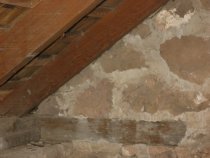
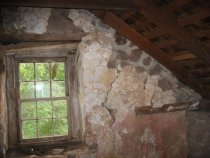
Interior views of plate-ties in gable walls |
Archive Number |
MFHPH52 |
Description |
Series of two digital images showing interior views of the eastern and western wall-plate ties [across lower range of photo] at the eaves level of the south gable wall. These oak timbers are approximately four feet long [the eastern element is slightly shorter from erosion] and six inches square in cross-section. They lap over the 1970-71 replacement wall plates, which consist of two stacked planks which are about the dimensions of typical floor joists of the period, laid flat on each eaves wall. A similar pair of ties appears in the north gable wall. These ties increase the compressive stability of the gable walls by interrupting ["breaking"] the mortar joints in the masonry, thus mitigating the possibility of long fractures radiating through contiguous and roughly vertical mortar joints{1}. Their primary structural function, however, is to resist lateral thrust imposed on the wall plates by roof and framing loads. This function is marginal because the frictional resistance in the bed mortar is minimal, and the compressive load bearing on the tie from the triangular masonry above is relatively insignificant. In circumstances where continuous tie beams were not feasible{2}, they were considered to be an imperfect but contributing method of stabilizing the eaves walls against the massive roof loads. FOOTNOTES: {1} Photos from the DeTurk House Collection in this archive show that a long fracture in the north gable wall, extending from grade to the eaves level, terminates at the underside of the plate tie embedded in the eastern segment of the wall. A similar severe fracture in the north gable wall of the Mouns Jones House [see photo MJHPH52--1000.01.056] was not interrupted by a plate tie or similar timber element and extended upward through the masonry joint-pathway to the sloping ["raking"] top of the gable wall. {2} Because of impediments such as chimneys, windows, and doors [DeTurk south gable, e.g.]. Tie beams are exponentially more effective in neutralizing thrust on wall plates by utilizing the lateral force component on each wall plate to restrain the reciprocal outward "push" on the opposite wall. To be mechanically efficient and to maintain "tensile equilibrium" in the beam, the ties must be well-joined(a) to the plates by one or more of the traditional techniques employed by timber joiners of the era. (a) also "joyned" or "jointed," in the early period |
Search Terms |
MFHPH MFPH MFH Michael Fulp House Michael Fulp House Photo Detail Photo Plate Tie Wall-plate Tie |
People |
Michael Fulp |
Object Name |
Print, Photographic |
Accession number |
1005.01 |
Date |
09/23/2010 |
Photographer |
Ward, Laurence |
Catalog Number |
1005.01.063 |