

Photo Record
Images
Additional Images [27]

Metadata
Collection |
George Douglass |
Title |
Masonry restoration |
Archive Number |
GDHPH14 |
Description |
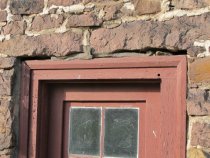
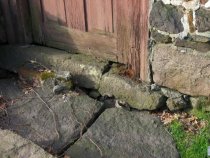
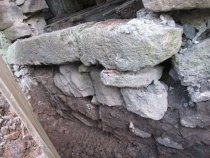
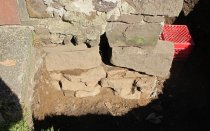
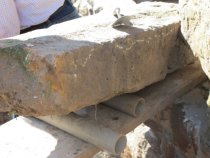
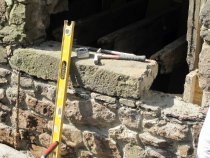
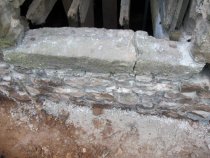
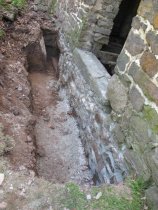
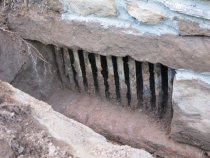
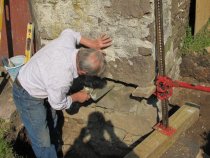
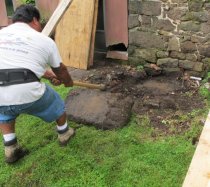
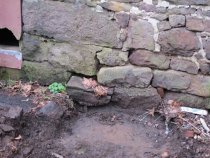
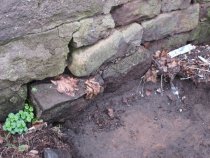
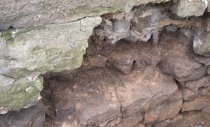
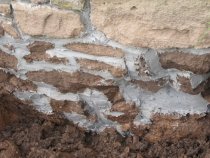
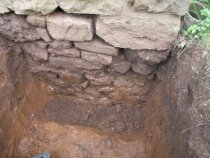
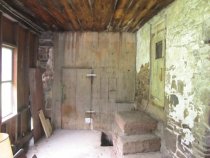
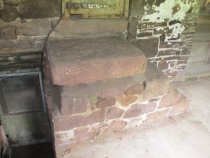
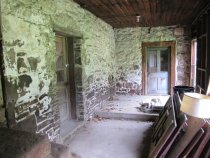
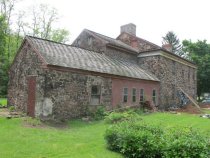
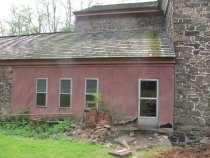
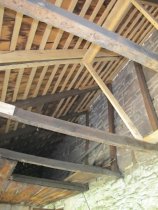
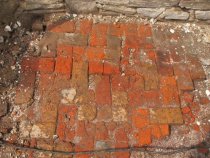
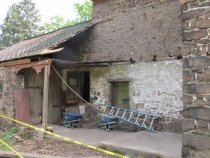
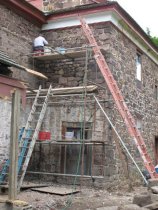
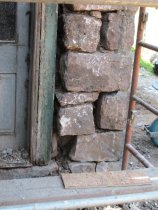
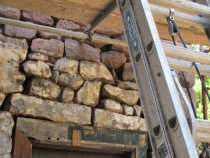
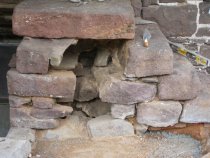
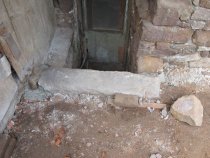
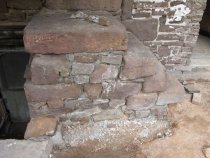
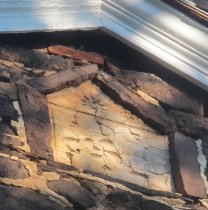
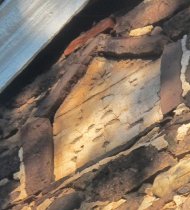
Series of 33 digital images depicting the masonry restoration work at the George Douglass House. The Trust’s Board of Directors resolved at its May, 2011 meeting to restore the three components of the George Douglass mansion and store structures to their historical and architectural "period of significance" ["period"]. The consensus of historians and consultants seems to converge on the time-span from 1765, the date of construction of the original house{n}, to the mid-19th century (probably prior to the Civil War) as the appropriate time-frame. It was during this period that George Douglass, his son George II, and their successors built the three structures and developed the diversified mercantile activities within this complex, which included butchering, trading in iron and other commodities, and a retail "country store" operation. This diversified enterprise evolved and flourished from prior to the Revolutionary War into the first half of the 20th century. Based on this history and extensive research into public documents and Douglass store records, the period of significance was tentatively determined to be 1765 to c.1840. The earliest building, George Douglass’s impressive "double-pile" five-bay Georgian house, was built in 1765 according to the date-niche in the north gable. The three-bay store addition, literally an extension of the early house in a more vernacular interpretation of the Georgian vocabulary, is not perfectly aligned structurally or conformed in detail to the 1765 house. Although a federal-period structure probably built between the Revolutionary War and the War of 1812, the extension is not "federal" in architectural composition, structural technique, or iconic classical-revival design details. The second addition is a one and a half story structure of random rubble masonry, apparently used for the butchering operation, probably for storage and sale of goods, and for curing meats in the "smoke-chamber" above the barrel-vaulted vegetable [root] storage cellar. It was probably constructed prior to the Civil War, and perhaps as early as 1830, and has been serially altered in fenestration and roof framing during the past century. A "smoke house" (probably not the extant smoke chamber) functioned within the Douglass-Jenkins store enterprise as of 1803 or earlier, according to an entry[n] on the pastedown sheet inside of the front board of the store day-book covering that period. [n] Tallying chronologically the varying quantities of pork in the smoke house. Sometime in the 20th century the owners enclosed the "store-yard"{x} area between the three period buildings with a frame wall sheathed with an inexpensive composition material, roofed the entire rectangular space defined by gable walls of the 1765 house and the second addition--and the eaves wall of the "federal" addition--and floored the resulting "porch" with a thick slab of modern concrete. All of these "improvements" facilitated human passage and movement of merchandise in and out of the five doorways protected by the enclosure. However, they also intruded modern materials into and abutting the historic structures and their "curtilage", and obscured the architectural and functional demarcations between the three interdependent buildings. {x} See record GDR11FN1--1006.01.022 for photos and discussion of the restoration of this yard area, undoubtedly a busy zone at the height of activity in the 19th and early 20th centuries, and the contiguous domestic and mercantile structures and architectural elements preserved or re-created in their form in the period of significance. The preliminary phase of the restoration campaign required removal of the "porch" roofing, the frame-wall connecting the northeast corner of the second addition and the southeast corner of the 1763 house, and the concrete slabs{1} along the foundation walls, including the south gable wall of the small addition to the south. Once these barriers and impediments were removed, the first phases of the stabilization and restoration work on the rear [east] elevations included: A. Excavation and stabilization of sub-grade foundation masonry. Much of the foundation mortar had been transformed into a plastic and disintegrated residue of clay, sand, and lime chunks. The majority of foundation ranges along all east elevations required re-setting displaced stone "units"; deep-pointing the beds and joints; filling voids with stone "pins" and mortar; and underpinning overhanging ["cantilevered"] stones with base-blocks masoned to the optimum shape. The joint and bed mortar was recessed ["held-back"] pending the pointing campaign for the entire building; B. Re-structuring the disintegrated stone steps and stoop at the raised entry to the smoke-chamber between the store addition and the one-story second addition to its south; this stair-block had become detached from the masonry supporting the entry sill of the smoke-chamber, and was noticeably out-of-plumb, leaning toward the east. It was restored to a plumb and stable condition, including the core and base of the raised stoop; see photos #4013 [dismantled core] and # 4022 [reconstructed stair-block].; C. Consolidating and deep-pointing the east bay of the south gable wall of the 1765 house up to the cove cornice [also "cove soffit"], and including: 1) filling in the open joint at the interior corner between the 1763 house and the federal-period extension with small stone "flags", "pins", and mortar; 2) stabilizing the rotated and laterally displaced stones of the "quoin" corner pier and inserting stone flags in larger voids; 3) filling in the gaps and voids above the gable doorway near the southeast corner and on either side of the frame. D. Raising the top step of the stairs to the vegetable cellar to meet the required brick paving elevations; re-grading the store-yard for positive drainage across the restored brick paving, and pitching it away from all building walls and doorways toward a central swale and to the unpaved area east of the paving; E. Resetting the stone sill under the center doorway in the 1763 Georgian mansion, and stabilizing the foundation supporting the doorway masonry and framing; F. Resetting a large dislodged sub-grade stone in the southeast corner of the later ancillary addition, and consolidating the corner pier it supports; this "quoin" corner pier was reconstructed and re-aligned vertically in conjunction with dismantling and re-erecting a majority of the south gable wall [see archive record GDR11PH1--1006.01.021, Image #3493]. DETAILED CAPTIONS 3268, 4/21/11: Two large stones on the lintel of the door frame in the east eaves wall of the 1763 George Douglass house. Rural builders of the period experimented with numerous devices to relieve timber framing at window and doorway openings of some of the wall and roof loads imposed upon them. The stones shown here are not embedded into the abutting masonry far enough to serve as true cantilevers, and might therefore be called "pseudo-cantilevers," which will serve only marginally as load-relieving elements. Nor do they function as a "flat" or "jack" arch, since there is no central "keystone" wedge, properly angled at the joint with the horizontal components of the "arch," to discharge a significant portion of the incumbent load laterally to the masonry piers or wall ranges flanking the wooden jambs of the frame. A single stone lintel, embedded the critical distance into the abutments and adequately sized, would have been a simpler and mechanically more effective load-reliever than this pair of stones. The deployment of the pair of stones shown here basically transmitted the wall load above the doorway directly onto the wood lintel, not the desired structural outcome. Fortunately, such redundant techniques were not essential because of the bearing capacity of the robust wooden frame and the timber lintel supporting the interior half of the wall. 3267, 4/21/11: Fractured (and rotated inward) stone sill [frequently "cill’ in documents and literature of the 18th and early 19th centuries] at east doorway of 1765 house 3432, 5/9/11: Broken sill and deteriorated foundation; raking out the clay-gravel "mortar" from the joints and beds revealed the lack of any sound [deletion] bearing mortar 3493, 5/11/11: Laterally displaced and rotated corner block ["quoin" stone, from the French term for "corner’; also "coin" in early Anglo-American vernacular terminology] below grade at the southeast corner pier of the ancillary (c.1830-40) addition. Although "quoins" have occasionally been referred to as "decorative"[a], or as a means of squaring corners of random or coursed rubble structures, it seems clear that another important function is to "tie’ the intersecting walls together with the compressive force of the heavier and longer "quoin" blocks bearing on the mortar joints between the smaller stones bearing the quoins in the perpendicular wall ranges abutting the corners. Surviving American buildings employing quoins typically lay them horizontally in alternating header and stretcher alignment. Primitive corners laid with stones larger than the those in the random walling appear in very early European masonry practice since the early mediaeval period, sometimes stacked vertically, sometimes alternating horizontally and vertically, and occasionally in hybrid and random forms of more massive blocks which were not "decorative" but have stabilized the corners of buildings which have survived for a millennium or more. [a] more appropriate in "dressed"[b] ashlar walls, which in early expressions featured quoins which projected beyond the common plane ["naked"] of the wall, creating a shadow effect in appropriate light. The relief between the tooled planes of the quoins and the ranges of random rubble walling does present an elegant refinement at their meetings. [b] also, in early masonry craft usage, "planed smooth", "tooled", "chiseled", or "boasted". 3486, 5/11/11: Rolling 1763 door sill-stone onto restructured and leveled foundation 3495, 5/11/11: Larger sill-stone in place; smaller piece of fractured sill to be inserted 3496, 5/11/11: Chiseling ["pitching-off"] excess stone from smaller stone segment of door-sill. The same technique was used to taper the stone step inserted under the top step of the stairs to the root cellar when the top riser was raised three inches 3513, 5/11/11: Both sill pieces in place, anchored in the abutting "pockets" in the masonry jambs; the foundation below the sill has been stabilized and packed with mortar 3514, 5/11/11: Perspective view of wider range of foundation below doorway and abutting walling 3510, 5/11/11: Iron-bar grille [uncovered when foundation was excavated for inspection] in cellar vent to south of centered doorway in east wall of 1765 house. This type of grille set in the opening for cellar lighting and ventilating was typical in the period in this region; see records DTR09FN12--1001.01.248 and BKR10FN4--1005.01.067 3539, 5/12/11: Using a high bearing-capacity jack as a shoring device during re-setting of sub-grade stone in southeast corner of the ancillary addition; this "lift" enabled the mason to remove small stones from above the displaced "quoin," supporting the load it bore, allowing it to be re-aligned while keeping the corner pier "in compression" during the repair 3590, 5/16/11: Pulling paving stone from foundation, revealing dislodged foundation stones at grade 3591 & 3592: Detail views of unstable foundation segments 3598, 5/18/11: Collapsed foundation segment after removal of soils [mostly clay] providing lateral support 3690, 5/24/11: Deeply and fully mortared joints in repaired sub-grade foundation ranges. In below-grade applications, and thus absent any aesthetic considerations, the joints are filled-out "flush" to the plane of the wall 3617, 5/23/11: Open foundation joints, lacking mortar where persistent saturation from moisture retained in clay-laden bearing soils has dissolved much of the lime, leaving a low-viscosity muddy residue providing minimal bonding quality in the wall 3631, 5/23/11: Doorways to second addition [left, through vertical-board wall] and to smoke chamber [right, up stone steps] before removal of 20th-century frame wall [left] and board ceiling 3633, 5/23/11: Stone stoop on masonry stair-block at entry to smoke chamber; the entire structure has become detached from the foundation below the doorway 3639, 5/23/11: Doorways to store addition [left] and into east bay, near the southeast corner of the south gable wall of the 1765 house; concrete slab is a 20th-century paving over earlier [probably 19th-century] brick paving 3647, 5/23/11: The three period Douglass buildings, with [red] frame wall concealing most of east eaves wall of federal-period addition and all five doorways opening on the store-yard framed by the three buildings composing the house-store complex during their first century of development 3645, 5/23/11: Detail view of the 20th-century frame ["stud"] wall 3743, 5/27/11: Board ceiling over "porch" enclosure has been removed, except the portion under the roof extension which will remain as hood over three of the doorways opening on the enclosed yard 4009, 6/17/11: Brick paving found near eaves wall of federal-period central section, under 20th-century concrete slab 3871, 6/7/11: The exterior space common to all three buildings forming the Douglass house and store buildings; the roof over the "porch" has been removed, leaving a roof-extension "hood" over the three doorways relating to the small addition, used for food storage, preparation, and cooking [in a large fireplace, since removed] to the south of the federal-period store extension of the 1765 house 3976, 6/14,11: Deep-pointing the east bay of the south gable wall of the original house up to the cove cornice ["soffit"]; mortar in the joints was "held back" for future re-pointing 4006, 6/15/11: Displaced stones at corner of early house; rotated stone above fractured sill 4008, 6/15/11: Stonework above doorway will be consolidated with deeply packed bed mortar 4013, 6/17/11: Cavity under stoop at entry to smoke chamber, after removal of disintegrated stonework 4018, 6/18/11: Top step of stair to vegetable cellar, before insertion of new step underneath the top landing and prior to re-grading of yard with 19th century bricks found within Morlatton Village 4022, 6/18/11: Stoop-support restored FOOTNOTE {n} The mortar-pargeted date-niche in the northeast gable, although quite eroded, appears to read "1765" [photos #3112 and 3113]. The numerals "1" and "7" are just above the base of the niche; the "6" and the "5" flank the "D" below the vernacular sunburst motif under the apex. An essay entitled Down The Schuylkill Valley, published in The Pennsylvania German Vol. III, No. 1, issued January, 1902, recites that "There is another old building nearby [to the Mouns Jones House], erected in 1765, which was for many years the mansion of George Douglass…." Although the date-niche is not mentioned, it might reasonably be assumed that the author and other "pilgrims" accompanying him noticed the "datestone" (when, 111 years ago, it was certainly less eroded) as their reference for the 1765 construction date quoted. {1} Six tons of concrete were removed, uncovering early brick paving in the yard area defined by the three walls of the period structures. The sound brickwork will be restored and preserved, and unpaved areas and areas where the modern concrete destroyed or severely damaged the bricks will be paved with similar bricks found at the Douglass buildings or at other sites within Morlatton Village [more correctly, according to research by Philip Pendleton, "Molatton" or "Molatten"]. These pavers range between 8 and 9 inches long and average 3.5 to 4 inches wide, and 2 to 2.5 inches thick. Larry Ward, 2016 |
Search Terms |
GDH GDHPH George Douglass House George Douglass House Photo Detail Photo Restoration Restoration Photo Quoin Sill Cill Masonry Restoration Datestone Niche |
People |
Douglass, George |
Object Name |
Print, Photographic |
Accession number |
1006.01 |
Date |
May-June 2011 |
Photographer |
Ward, Laurence |
Catalog Number |
1006.01.021 |