

Photo Record
Images
Metadata
Collection |
DeTurk |
Title |
Southeast perspective view from postcard |
Archive Number |
DTHPH48 |
Description |
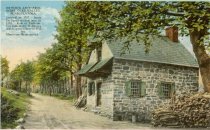
Digital image of a tinted postcard print created from photograph by H. Winslow Fegley, showing a perspective view of the east [right] and south [left] elevations of house. Details shown include: pent roofs, gable hood, gable-end chimney, 19th-century slate roof, doors with later glazed sash, window sash, paneled shutters, stone stoop. Full text on front of card reads as follows: "DE TURCK ANCESTRAL HOME, OLEY VALLEY, PENNSYLVANIA. Erected in 1767. Isaac De Turck settled here{1} in 1712. Kiob or Tschoop, the last of the Mohicans was baptized here{2} in 1742 by Moravian Missionaries." In his pioneering essay "Colonial Architecture of the Pennsylvania Germans," published by the Pennsylvania German Society in 1931, Edwin G. Brumbaugh wrote, referring to the 1767 DeTurk building seen in this postcard: "…aside from its architecture, the building is of first rank historically" because of the "unification" conference initiated by Count Zinzendorf, which was "held within the narrow limits of its walls"{3} in February, 1742. The caption to plate 32 of Brumbaugh's book, a halftone image from a photograph of this DeTurk House, recites: "The John DeTurk House, Oley Valley. In this house the famous ‘Oley Conference’ is said to have been held." For further details on this "anachronism", see record # DTHPH32 in these archives. Brumbaugh acknowledges the chronological problem presented by the 1767 dated lintel, but suggests that the apparent anachronism is explained by the possibility that the 1767 date refers to an alteration of the building, not the original construction date. He recognizes that the DeTurk "barn, no longer standing, or an earlier house, may have been the actual meeting place," but relies on the 1742 pamphlet published by Benjamin Franklin as establishing that the "synod" occurred "at John DeTurk’s house." Apparently Brumbaugh presumed that the 1767 building, embanked along the Little Manatawny ["Kauffman’s"] Creek, was the only DeTurk house extant on this farmstead site in February, 1742. Brumbaugh was obvously not aware of, or didn’t recognize, the c.1740 DeTurk house, located within fifty yards to the south of the 1767 "house"{4}, actually a multi-function building depicted and discussed by Philip E. Pendleton on page 113 of "Oley Valley Heritage, The Colonial Years: 1700-1775" [Pennsylvania German Society, 1994]. The Pendleton caption to the photograph of the c.1740 house and its extensions calls the southern bays of the enlarged dwelling the "Scene of Zinzendorf’s Third Synod, 1742." The southern section of the extended farmhouse was the locus of the earliest stone house. In the 1950s, a large 18th century fireplace and chimney breast were removed from the kitchen space at the southern gable end of the composite structure still standing. Unused verso of postcard bears imprint of H. Winslow Fegley, photographer, Reading, Berks Co., PA No framing or masonry evidence appears between north window sill and woodpile to suggest existence of pent hood over doorway. However, the anchor-beam ["header"] between joists above the eastern doorway of the lower level, in the cellar-kitchen wall confirms that the outlookers were original 1767 construction and provided the vertical projection supporting the clay-tiled hood. The rafter geometry, pitch, and exposure dimension of the tiles were worked out from the dimensions and spacing of original framing remnants. FOOTNOTES: {1} i.e., on this tract, probably in a log dwelling. {2} Because the building depicted on the postcard did not exist in 1742, "here", in this context and for the reasons summarized above and in Archive record #DTHPH32, should be interpreted to mean: "on the DeTurk farmstead site [tract 3 on the plat-map on p. 198 of Pendleton, op. cited above], but in an earlier building". {3} Brumbaugh mused: "How they all crowded into the little house is a puzzle." On page 41 of his essay, Brumbaugh speculates that the "large" room [about 15 feet by about 20 feet of interior space] on the first floor had been altered "to enable the house to be used as a meeting place and center of Moravian activities." It is extremely doubtful that the 1767 multi-function structure had ever accommodated a congregation of any meaningful number. There is no evidence within the structure, foundation walling, or "fabric" of the building that it had been enlarged or otherwise significantly modified. The single room on the upper level [above the embanked kitchen and root cellar ] was carefully laid out as a residence for the aging DeTurk couple, with a small heating fireplace, shelving and a cupboard flanking the fireplace, and a longitudinal "summer" beam carrying the short transverse floor joists. All of these elements survive and function in their original intact forms, unaltered in any manner reflecting an enlargement of the space for religious or social gatherings. {4} on page 42 Brumbaugh labels the 1767 structure as "really a stone cabin." Compelling documentary and architectural evidence demonstrate that the 1767 building was deliberately and efficiently designed to serve several "ancillary" functions: a classic Germanic "Grossmutter’s" retirement dwelling; a lower level ["downbank"] cooking kitchen with a large fireplace to serve other residents and workers on the farmstead as well as the grandparents living space one story above ["upbank"]; a barrel-vaulted food storage ["root"] cellar; an attic storage "granary" with an exterior access-door in the south gable wall; and a "wash-house" [as it was called in a DeTurk Will] for the occupants and their family members residing in the expanded 1740s farmhouse across the lane to the south. L. Ward, updated October 2021 |
Search Terms |
De Turck De Turk DeTurck DeTurk DeTurk Family History DeTurk Genealogy DeTurk House DeTurk Photo DTHPH DTPH DTH DT Fegley Photo Gable-End Chimney granary Grossmutter Moravian Pent Eaves Pent Hood post card root cellar Vintage Photo anchor-beam Oley Conference |
People |
DeTurk, Isaac DeTurk, Johan DeTurk, Johannes DeTurk, John Fegley, H. Winslow |
Object Name |
Postcard |
Accession number |
1001.01 |
Date |
c.1915-1918 |
Photographer |
Fegley, H. Winslow |
Notes |
-Image is owned by Historical Society of Berks County. -Only the front of postcard was provided. Further info (i.e. date of creation, publisher, etc.) may be found on original at HSBC. |
Catalog Number |
1001.01.037 |