

Photo Record
Images
Additional Images [12]
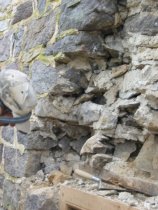
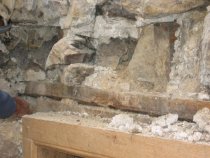
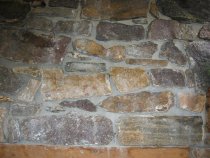
![#15 - 1634:Exposed Joist and anchor beam ["header"] above doorway](https://s3.amazonaws.com/pastperfectonline/images/museum_296/001/thumbs/100101184-15.jpg)
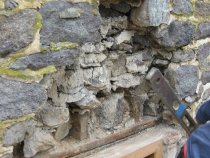
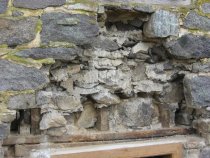
Metadata
Collection |
DeTurk |
Title |
Photo series showing historic masonry wall restoration |
Archive Number |
DTR09PH92 |
Description |
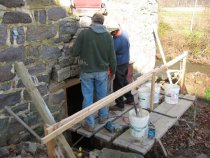
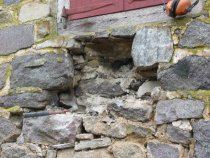
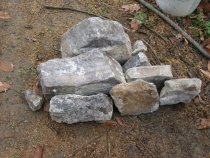
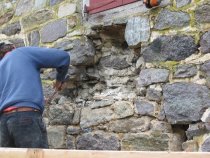
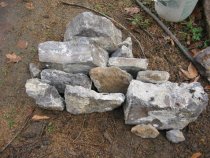
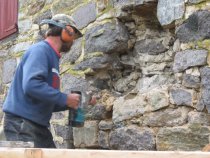
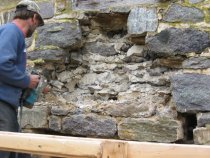
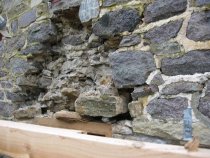
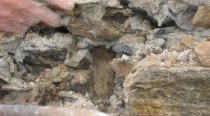
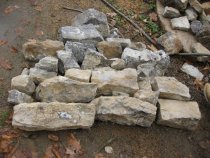
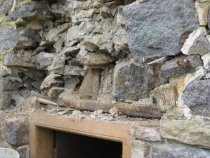
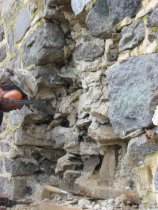
18 chronological photos of the December, 2009 restoration of a distended, de-laminated, and destabilized segment of DeTurk east eaves wall above the kitchen cellar doorway. Details shown in this series include exposed end-grain of first floor joists; tiered pair of oak relieving plates, one a joist-bearing ["leveling"] plank, the other a member relieving plates "carrying" wall and roof loads across door and window openings and embedded in wall above doorway lintel; masonry openings for hood outlookers; several generations of bonding and pointing mortar; dismantled core of random-rubble masonry wall segment; and the technique and sequence applied in replicating the positions and bonding patterns of the restored stonework. This series of photos shows the masons dismantling and resetting the roughly arched 15-cubic-foot segment of stonework above the ground-level cellar-kitchen doorway in December, 2009. This wall section, between the lintel and the first floor window sill above, had become destabilized, bowed outward from the plumb wall-plane, and slightly delaminated. It had undoubtedly been re-worked, probably more than once, when the doorway was raised incrementally as the brick-paved cellar floor was filled-in by several generations of occupants [see Field Notes drawing DTR09FN3--1001.01.176]. Photo DTR09PH106--1001.01.202 shows the later [and poorly color-matched] pointing in the unstable, pre-restoration wall range. The five "pockets" [or "sockets"] in horizontal alignment in masonry joints under the window in photo DTR09PH106--1001.01.202 were cut-in for lath supports ["rafters"] for the non-original shed-form hood appearing over the kitchen doorway for most of the last century, as seen in numerous 20th-century photos in this archive, including several HABS photos. These photos show experienced restoration masons carefully resetting the exterior layer of stones in the same relative positions as they occupied prior to restoration by laying the stones on the ground [photos with captions beginning 1622, 1624, & 1629] in their wall-position configuration, except that they are "face-down" while on the ground. The stones are then "backed" into position and laid-up in a plumb vertical alignment with respect to the stable plane of the contiguous ranges of the wall. This helps assure that the wall will remain well integrated, stable and "in compression. " {1} Structural efficiency of the wall under the normal stresses from compressive, oblique, and eccentric loads and thrusts acting through it is optimized by carefully packing ["mudding-in"] bed mortar into all voids and gaps between stones, which were selected and masoned [cut or "hewn"] to fit into the spaces available and mitigate movement within the wall as it is laid-up. This process, when conceived and executed by masons experienced in the traditional techniques, creates a virtually monolithic wall mass which supports and neutralizes "dead" and "live" compressive and tensile loads, stresses, and thrusts imposed on the structure. The redundancy{2} of this system includes keying ["toothing"] stones from one vertical segment ["wythes"] of a wall to adjacent wall layers, reciprocally buttressing and binding at masonry quoin corners, and the corbelling of stone layers and courses in a wall range. The cantilevered "corbel-arch" formed by the stones remaining in place [photos #1632 & 1635] is an example of structural redundancy sufficient to temporarily support the wall mass above the cavity during the restoration process. This "over-built" quality is essential to the survival and durability of "random"{3} rubble masonry structures. Record DTR09PH112--1001.01.208 shows and describes the de-constructed wall segment and its exposed details. Photo #1954 shows a restored view of this wall segment prior to repointing, which was completed in 2010. FOOTNOTES: {1} In general terms, stable "compression" is maintained when the net force vectors ("lines of force") from gravitational, oblique, and variable loads, are confined to the central core ("middle third") of a wall. {2} In modern structural engineering terminology, "redundancy" denotes the supplemental configurations and components introduced into a structure to reinforce or compensate for primary stabilizing elements which might become stressed to the point of failure ["strained"]. The term is used in the vernacular context of the DeTurk house to collectively define the integrated components, which compensate for potential inadequacies in the materials, design, and/or construction methods intended to provide primary structural equilibrium in timber-frame randon rubble stone buildings. In timber-framed random rubble masonry, examples of such redundancy include thick wall sections, natural and fabricated "footings" wider than the foundation’s thickness, corbels, reciprocating corner "quoins", "summer" beams, embedded wall beams ["spreader" plates], relieving arches, tie-beams and oversized or excessive timber bracing, among others. {3} "Random" only in laying up the wall with stones of varying sizes and shapes without regard to establishing horizontal courses; decidedly not "random" in the sense of indiscriminate selection and placement and mortaring of stones in the wall. Random rubble masonry thus conforms to the traditional definition of stone "masonry" as the skilled and efficient selection, shaping and joining of stones into walls, arches, and other structures. Laurence Ward, 2009, updated April 2021 and September, 2022. |
Search Terms |
DTR09PH DTHPH DTR09 DT De Turck De Turk DeTurck DeTurk DeTurk Photo DeTurk House Bonding Mortar Random-rubble Masonry Embedded Wall Plates Corbel Arch Masonry Restoration Redundancy Structural Equilibrium DTHEDOL Wall core Joist plate Relieving plate Leveling plate Structural redundancy |
People |
DeTurk, John |
Object Name |
Print, Photographic |
Accession number |
1001.01 |
Date |
12/03/09 |
Photographer |
Larry Ward |
Catalog Number |
1001.01.184 |