

Photo Record
Images
Metadata
Collection |
Michael Fulp House |
Title |
Detail of northeast perspective view |
Archive Number |
MFHPH18 |
Description |
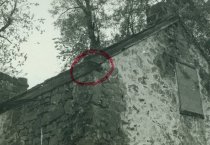
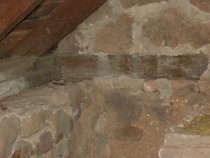
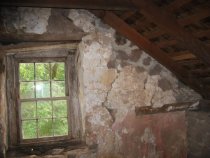
Digital image of a black & white photographic print showing detail of northeast perspective view of the c.1783 Fulp ["Bridge Keeper's"] House, and two additional colored photos. Circle in red marker draws attention to the exposed end-grain of the pre-1967 eastern eaves-wall rafter [sometimes "wall"] plate at its junction with the rake board on the north gable wall. The present [replacement] wall rafter plate{1} is marginally secured into the south gable wall by a short white oak plate-tie at each interior corner of the building [see images 2 & 3 (#208 & #211, 9/23/10), showing these ties in the southeast & southwest corners of the south gable]. Similar ties are embedded in each corner of the north gable and are lap-joined to the c.1971 replacement rafter plates. It seems safe to assume that similar plate-ties were part of the original structure; the builders could not have installed a continuous tie-beam across the full gable-span because of the impediments presented by the sloping chimney in the south gable and the attic window in the north. This structural technique appears in numerous random rubble masonry buildings in this period in the region [see DeTurk House photos through search term "Plate Tie"]. They were marginal substitutes for full-span tie beams which are mechanically connected to each wall plate by mortise-and-tenon or dovetail joinery, providing a reciprocal set of restraints, in "tensile equilibrium," against lateral thrust imposed by roof loads on rafter plates. These shorter ties rely mechanically on friction in the mortar joints and the relatively modest amount of compressive load from the incumbent gable masonry borne by them. Although deficient as structural stabilizers, these short timbers do have the beneficial effects of: (a) interrupting ["breaking"] the vertical mortar joints, thus inhibiting fractures migrating through contiguous joints [see DeTurk photo DTR09PH100] and (b) providing a true bearing plane for the triangular outer range of the interior wythe of the gable masonry at the eaves level [the ties in the DeTurk House are in the exterior wythes]. A preferable and structurally superior alternative to the "plate tie"for resisting outward thrust of the roof loads, is the mechanical joinder of the rafters to the upper-floor joists, which are then equivalent to tie beams. This eaves wall collapsed in 1967 [see MFHPH24--1005.01.025] after several years of inundation of the interior framing timber through a large breach in the west range of the roof [see photo MFHPH16--1005.01.017]. Since the early rafter plates were replaced in the 1970-71 restoration campaign, the original joinery between the wall plates and their ties cannot be determined. See photo records MFHPH22--1005.01.023 and MFHPH40--1005.01.041 for discussion of the stove chimney appearing [but since collapsed and removed] in this photo on the north [right] gable peak. Details include: parged random rubble masonry; stove chimney [upper-right]; gable-end chimney [left]; rake board; attic window in gable wall; plate tie; wall plate. Note in pencil on verso reads: "Toll House" (sic{2}) [unreadable direction] Wall -- showing cornice 6 x 8 plate on north [inserted with caret] wall-- beaded boarded [sic] on gable and wall 5" or 6." FOOTNOTES {1} The rafter plates on both eaves walls consist of two stacked timbers ["scantlings", or timber cut to prescribed dimensions, in this case approximately the size of floor joists], laid flat. The plate-tie laps over the top plank. The joinery between the two components of the composite plate and between the tie and the composite plate has not yet been determined {2} See MFHPH16--1005.01.017, pointing out that the "Toll [collector's, the Kulp family] House" was across the river from the Morlatton site, on the west side of the river in Union Township in 1876, as indicated on the Amity Township map on page 27 of the 1876 "Atlas of Berks County." The first bridge at this site, a substantial double-passage, two-span "Burr-arch truss" structure(a), was built c.1832-1833 by a private stock company nearly 25 years after the death of the first occupant of the "Bridge Keeper's" house, Michael Fulp. His modest dwelling was constructed by 1783, when a "stone house" on this lot (less than an acre) was first taxed to Fulp. Whether the site subsequently housed a "bridge keeper" remains undocumented. However, tradition says that one or more of its 19th-century occupants added snow to the bridge floor for sleigh traffic and hung lanterns at the portals. If true, this might be indicative of delegation of a broader set of responsibilities to a "keeper" or "tender." See also footnote {1} to record MFHPH16--1005.01.017. (a) See photos and history of this bridge, including discussion of the "keeper" issue, in archive record MVPH1--1003.01.002. |
Search Terms |
MFHPH MFPH MFH Michael Fulp House Michael Fulp House Photo Gable-end Chimney Detail Photo Random-rubble Masonry Rake Board Wall Plate Stove Chimney Barge Board Toll House Plate Tie Snow Vintage Photo Fulp House rafter plate |
People |
Fulp, Michael |
Object Name |
Print, Photographic |
Accession number |
1005.01 |
Date |
c.1966-1967 |
Photographer |
Unknown |
Catalog Number |
1005.01.019 |