

Photo Record
Images
Metadata
Collection |
Mouns Jones |
Title |
Restoration of Mouns Jones house |
Archive Number |
MJHPH13 |
Description |
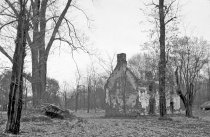
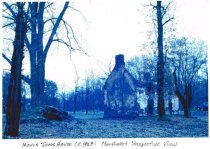
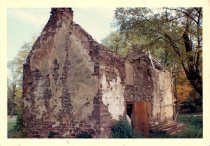
A series of three photographic views (image #1 is a digital image and #2 and 3 are color photographic prints) showing pre-restoration northwestern perspective views of the Mouns Jones House after the collapse of the roofing and flooring in the 1950s. Image #1 is a digital copy of a photographic print [Stauffer #1000], published here with the generous permission of the Historical Society of the Cocalico Valley, Ephrata, Pennsylvania, taken on November 4, 1962 at 4:30 PM by Harry Franklin Stauffer (1896-1979), self-identified "Printer and Tinker" of Farmersville, Lancaster County, PA. Stauffer, an accomplished architectural and landscape photographer, captioned this image in part as showing "Monce (Moses)[sic": "Mouns" was earlier "Mans", a contraction of "Magnus", after several Swedish Kings, further changed to Mounce for Mouns’s grandson] Jones House…left bank of the Schuylkill River…Arch Cellar on left [north of house]. Date stone removed within past year…" This is the first known view of the "arch"{1} cellar on this site, which has been the subject of a comprehensive archaeological excavation since 2013. The caption to the Stauffer photo is quoted from the Journal of the Historical Society of the Cocalico Valley, Volume XXXVIII, 2013, caption on p. 108. The long vertical fracture visible in the north gable wall has been repaired in Image #2 [see record MJHPH52--1000.01.056 for a 1967 view of the stone mason "weaving-in" the stonework flanking the fracture]. {1} sometimes "arched" [A. Long, p. 101], also "root", "cave" or "ground", and the modern term "cold", cellar, Long, pp. 156-167, all referring to below grade stone barrel-vaulted food storage chambers found on many farms in the region, often under a house or ancillary building. Examples documented in this archive include: the 1767 DeTurk "ancillary" building (the embanked vaulted chamber under the southern half of the first floor living space); the Keim farmstead, where the cellar, originally under a small stone building of unknown purpose, now has an exposed arch-form exterior ["extrados"] after removal of the gabled building late in the 19th century; and under a smoke chamber added to the George Douglass House and integrated functionally with its Amity store Federal-era addition. Images #2 and 3 are color photographs of Mouns Jones's house during restoration of its north gable wall, a perspective view from northwest, showing scaffolding against the north gable wall and remnants of the "stucco" pargeting covering all wall ranges visible in the c.1886 wood engraving [see record MJHDWG2--1000.01.089. The window in the second story, north [left] bay has been altered from its early horizontal or roughly square casement form to a vertical hung-sash type to match the other two windows in this elevation. Later in this 1965-70 restoration campaign, the three larger windows in this wall were restored to the casement alignment seen in the 1886 woodcut drawing [MJHDWG2--1000.01.089] and the photo in record MJHPH46. The window south [right] of the existing doorway, and within the original centered doorway opening, was replaced by a small square casement. Typed note attached to Image #2 reads: "Mouns Jones House or Old Swedes House built 1716 on 1701 cabin site{2}. Old Morlatton Village, first permanent settlement within the bounds of Berks County. Indians of the Five Nations met here on their way to meet with the Penns and the Provincial Councillars[sic]. Mouns Jones rode with them to Whitemarsh, a half way stop where the meeting was held. On the National Register of Historic Sites." This reference might rely on the letter from Mouns Jones dated May 4, 1712, to Pennsylvania Lieutenant Governor Gookin stating that four "Indian Kings" were at Manatawny and desired to meet the Royal Governor [name?] on May 8 at Mouns Jones' house; see Colonial Records Volume 2, page 569; letter cited in Brunner, "The Indians of Berks County" at page 10. The meeting did not take place because Mouns Jones' letter did not reach the Governor until May 9, one day too late because the Native American leaders were scheduled to meet in mid -May with their counterparts in the Five Nations tribes residing in New York. {2} The 10,000 acre Penn grant to the Swedish Pastor Andreas Rudman, representing prospective Swedish settlers in the Molatton/Manatawny region, originated in 1701. Mouns Jones received title ["patent"] to his land, close to 500 acres, in 1705. It is therefore doubtful that he erected a "cabin" as early as 1701; however, it is quite likely that Mouns Jones built a dwelling, probably a log cabin [or possibly a plank or board-sheathed structure], on the tract by 1704, when a letter from a Swedish Lutheran minister [Reverend Andreas Sandel] stated that Jones had "taken up residence" [also translated as "has begun to reside"] in Manatawny {n}. The first "residence" occupied by Mouns Jones, and probably in time by his wife and unmarried children, might be memorialized by the foundation walling and hearthstones found by Chapter 21 in the 2013-2018 archaeological campaign. {n} According to a paper written by Reverend John Heckwelder in 1822 entitled "Names given by The Lenni Lenape Or Delaware Indians To Rivers, Streams, Places…in the Now States of Pennsylvania…", the names for the creeks flowing into the Schuylkill River to the north (now "Monocacy") and south (now "Manatawny") of the Swedes' tract were as follows, confirming the numerous variations in spelling from phonetic transliteration: "Menatawny", from "Menetonink", reputedly meaning "where we drank (were drunk)." "Manakasy", from "Menagassi", meaning "creeks with some large bends". Heckwelder's glossary of these phonetic derivations was published in 1833 by the American Philosophical Society and more recently in Volume V of the publications of the Pennsylvania German Folklore Society (1940), on page 19. See additional discussion of the probable earlier Mouns Jones house on this site in MJHPH57--1000.01.061. The 1693 census of Swedes on the Delaware river includes as #23 Mans Jonasson…(Mounce Jones) who was born in 1663 and married c.1690 Ingeborg…They had one child Margaret [as of the 1693 census date]. The Sandel letter indicates that Mans journeyed up the Schuylkill River by 1704 to his plantation site (part of the "Swedes'' tract") in Manatawny [also called "Mahanatawny" in early official records (including the James Logan Ledgers at the Historical Society of Pennsylvania), Amity Township, Berks [then Philaldelphia] County. His wife Ingeborg and their unmarried children, 13 years of age and younger in 1704 joined Mouns in residence there within the next several years [see summary on page 38 of the article "The 1693 census of The Swedes on the Delaware" by Peter Stebbins Craig, J.D., published in Studies in Swedish American Genealogy 3 by SAG Publications, Winter Park, Florida in 1993]. Image #1: Mouns Jones House, NW perspective view before restoration, (1962). Laurence Ward, April, 2019 |
Search Terms |
MJPH MJH Mouns Jones Photo Mouns Jones House MJHPH Mouns Jones House Photo Old Swede's House Perspective Photo Gable-end Chimney Vintage Photo Vintage Photo Pargeing Window Frame Hung-sash Window 1704 Letter Swedish Census Manatawny Mahanatawny Monotony Monocacy Creek Manatawny Creek Menatawny Menetonink Creek Manakasy Menagassi Creek Arch Cellar Cave Cellar |
People |
Craig, Peter Stebbins Heckwelder, John Jones, Mouns Sandel, Rev. Andreas Stauffer, Henry Franklin |
Object Name |
Print, Photographic |
Accession number |
1000.01 |
Date |
c.1960-65 |
Photographer |
Stauffer, Harry Franklin (image #1); Unknown (image#2) |
Notes |
Image #1 published here with the generous permission of the Historical Society of the Cocalico Valley, Ephrata, Pennsylvania |
Catalog Number |
1000.01.013 |