

Photo Record
Images
Metadata
Collection |
DeTurk |
Title |
Southeast perspective view |
Archive Number |
DTHPH32 |
Description |
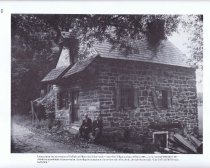
Digital image of perspective view from southeast, scanned from a halftone reproduction of a photograph appearing in "The Passing Scene," vol. 3, page 194 by George M. Meiser, IX. Details include: altered Dutch door (glazed sash added); gabled hood over granary [attic] door; gable-end chimney; east pent hood outlookers [lacks frame and roofing]; paneled shutters; butt-shingled pent roofs on south gable wall. See notes for additional information supplied by Oley Woman's Club Papers, concerning image origin and identification of men pictured in image. Johann DeTurk [also DeTurck] was born in Oley in 1713 and became part of the local Moravian congregation in 1741, the year before the famous ecumenical conference which was held at his farm, and was baptized in 1743 [see "Genealogical Data From the Registers of the Moravian Congregation in the Oley Valley, Berks County, Pennsylvania" by Rink & Weiser, published in "Der Regebogge/The Rainbow, Quarterly of the Pennsylvania German Society," Volume 14, Number 1, January, 1980, page 8.] Larry Ward, 2016 |
Search Terms |
DTHPH DTPH DTH DT De Turck De Turk DeTurck DeTurk DeTurk House DeTurk Photo Dutch Door Outlooker Pent Roof Pent Hood Paneled Shutter Oley Woman's Club Oley Woman's Club Papers Shutter Shutters Window Sash Vintage Photo Gable-end Chimney Shingles Butt Shingle Shingled Pent Roof Moravian Moravian Synod |
People |
DeTurk, John Stahr, Rev. Isaac Meiser, George |
Object Name |
Print, Photographic |
Accession number |
1001.01 |
Date |
c.1909 |
Photographer |
Unknown |
Notes |
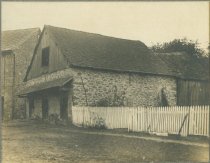
Image reproduced with generous permission of George M. Meiser, IX from his book "The Passing Scene," vol. 3, page 194, published in Reading, 1984. Please note: Trust only has access to the digital image reproduced in this archive. Original material is part of a private collection. Additional info supplied from the Oley Women's Club Papers: "Photograph included in the "Reading Eagle'"of Sunday, November 28, 1909, page 12 - article entitled "Early History of the Fertile Oley Valley." This is the earliest article found to show a photograph of the 1767 house. One of the two men seated in front of the house has been idenitified as the late Rev. Issac Stahr by his daughter, Mary Stahr. The same photograph appears again in the Reading Eagle of Sunday, December 31, 1916, page 20 article entitled "Great religious Revival Which Occurred in Oley Valley 175 Years Ago."{n} Also included with this article is a photograph of the Moravian Meeting House, which disintegrated gradually and finally collapsed in the 1950s. {n} A common misconception in the first half of the 20th century held that the c.1742 Moravian Synod ["Conferenz", as described in the pamphlet published contemporaneously by Benjamin Franklin] took place in the ancillary structure depicted in this record; See Langdon, "Everyday Things in American Life, 1607-1776," Charles Scibner's Sons (1937), pages 79 et seq., which acknowledges the disparity of twenty five years between the Conference and the 1767 date inscribed in the lintel above the upper door in the south gable, but attempts to explain the ambiguity by suggesting that the 1767 date does not represent the construction date of the "cabin." In the caption to Plate 32 of his pioneering survey of "Colonial Architecture of the Pennsylvania Germans," Pennsylvania German Society (1931), G. Edwin Brumbaugh states "In this house the famous 'Oley Conference' is said to have been held." The caption to the c.1915 postcard view of the building in record DTHPH48--1001.01.037 asserts the same anachronism appearing in the two sources cited above. Although all of these writers were aware of the 1767 date inscribed in the upper lintel, they all apparently rationalized that this multi-function building must have been THE "John DeTurk's house" cited in Franklin's 1742 pamphlet as the locus of Zinzendorf's ambitious meeting. These and other early commentators were apparently unaware of one crucial fact: The earlier (c.1740) DeTurk stone house had been integrated structurally and visually into the extended family farm house just a few yards from the ancillary structure to the southeast, and was thus undiscernible as the DeTurk "house" in which the Moravian Conference was probably held. Because of the number attending the conference, some writers, including Brumbaugh, have reasonably surmised that the ecumenical gathering was held in a barn on the farmstead, possibly an antecedent to the English-style barn seen in image #2 in this record. This would require translation of "house"["haus"] in the title of Franklin’s pamphlet to mean "home," in the broader sense denoting the farmstead’s house and its outbuildings ["dependencies"]. |
Catalog Number |
1001.01.060 |