

Photo Record
Images

Additional Images [14]

Metadata
Collection |
Michael Fulp House |
Title |
Restoring the cellar bulkhead entry |
Archive Number |
MFHPH59 |
Description |
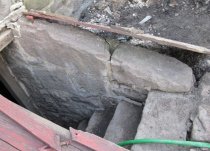
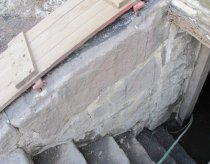
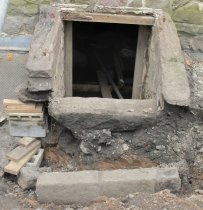
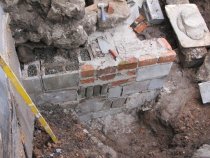
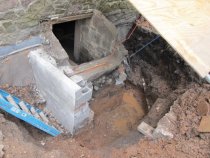
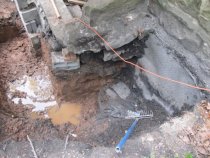
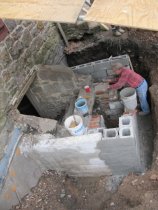
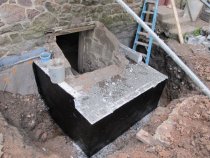
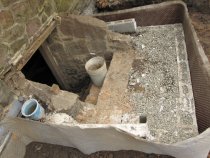
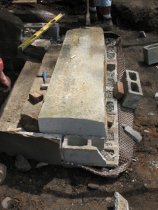
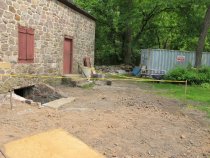
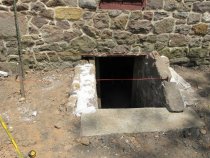
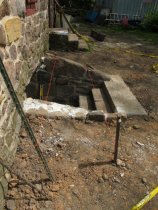
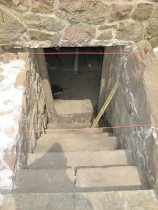
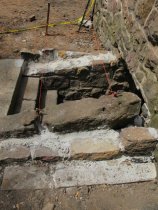
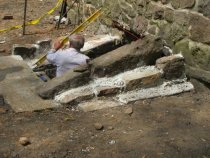
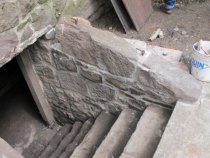
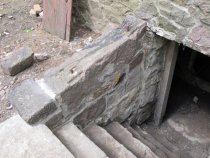
Series of 20 digital photos taken during the restoration of the bulkhead cellar entry at the Michael Fulp (Bridge Keeper's) House. During or shortly after every rainfall of a half-inch or more in a 24 hour period in the past several decades, several inches of water (occasionally 6-8 inches or more) would cover the cellar floor, remaining for several days or longer, unless pumped out, because of the relatively impervious clay bearing the foundation and blocking outflow from the cellar. It was determined that the bulk of the incursion was from 2 sources: ground runoff down the cellar stairs, and percolation through saturated bearing soils and permeable fill. Most of this accumulation was the result of the lack of a moisture barrier outside the flank walls and beneath the top step-stone. The bearing and lateral support for the steps and flanks consisted primarily of permeable soils, clay, gravel, and minimal bearing or "footing" stones. The cellar entry, situated in a shallow grade-basin, was a virtual "funnel" for pooled ground runoff, plus the flow from the roof drip-edge above the bulkhead. The remediation plan consisted of three elements: A. Raising the entire bulkhead entry structure 6 inches above the prior levels, and adding a granite stone slab landing ["S6" in drawing, 65 inches long, 18 inches wide, which varies in thickness from 6 inches at the riser to 11 inches at its outer face] above the previous level of the top step ["S1"] of the staircase. This massive upper-landing stone was "man-handled" into position and will dam much of the ambient ground runoff which flows to the perimeter of the bulkhead structure. B. Laying up a continuous perimeter wall of concrete block to support and buttress the flank walls, the raking cap stones, the shoulder-walls abutting the flanks, and the added upper landing stone. The outer face of the sub-grade block wall was pargeted with mortar, which was then brush-coated with a waterproofing fluid; then both coatings were covered with a single continuous sheet of "dimpled" drainage board [Delta-Drain] with an adhering filter-fabric [the same "geotextile"-lined moisture barrier which was installed against the foundation exterior of the entire building]. The lower segment of this impervious sheet material was folded 90 degrees and extended outward across the excavation floor in order to direct the down-flow through the dimpled openings and away from the base of the block wall, set on a "lean concrete" footing pad, consisting of relatively dry ["stiff"] mortar and 2B stone. Water at this level will flow into the perimeter drains around the foundation walls and footings [see MFR10FN2--1005.01.058], and thus be conducted away from the foundation. This diversion system has been calculated to remove thousands of gallons of water from the building perimeter in a few hours, rather than the days during which water would be detained prior to this modification. Withdrawal of these large volumes of fluid substantially diminishes the hydrostatic and hydrodynamic pressures acting on the sub-grade walling. C. Fabricating and installing new board and batten doors hung on the existing pintles{1} leaded or mortared into the angled "capstones" ["rakes"], now positioned 6 inches above their former elevation. After completion of this project, no significant water appeared on the cellar floor, despite more than an inch of rainfall in the region on several occasions. Similar rainfalls previously produced several inches of water in the cellar, which typically remained in the cellar for days or weeks unless pumped out. SEE Field Notes drawing of plans, elevations and details of this modification in record MFR10FN3--1005.01.065. Although "bulkhead" cellar entries {2} existed in the 18th century, few original examples have survived or been documented. Photos #3274 & #3580 in this record show the mortared joint between the triangular flank walls ["cheeks"(a)] and the original building wall, indicating that the bulkhead was added to the Fulp cellar-way sometime later than the original 1782-3 construction campaign. This addition could quite possibly have occurred shortly after George Douglass II’s purchase of the house from the estate of Michael Fulp in 1808-09, when Douglass probably made other improvements. (a) raking triangular side-walls, similar to the side walls of roof dormers, sheathing the timber framing supporting the angled doors. In contrast to the retrofitted Fulp "bulkhead" cellar entry, masonry evidence indicates that retaining walls, probably supporting a wooden "cellar cap," were part of the original construction of the 1753 Jacob Keim house in Pike Township [see archive record KR11PH1--1002.01.087]. Similar stone flank-walls ["cheeks"] are joined to the east eaves wall foundation as part of the rear cellar entry to the White Horse Inn [see archive record WHTPHXXX]. The 1786 Carpenters Company "Rule [Pricing] Book" does not include a specific reference to "bulkhead" doors in describing "Cellar" doors. However, the details for pricing these doors state: "Cellar doors ledg’d [battened], about four feet wide of pine [or red cedar] boards sap’d, and hung double, the cheeks and sills of pine…." The same entry also provides for "Lintels over cellar doors, or posts to support the doors when open’d…." Plate VIII appended to the "Rules" shows shingled "cheeks" on a "flat-topped" [shed-form] dormer. Similar wording appears in the 1797 Chester County Practical Carpenter’s Guide, although this pricing manual specifies stone cheeks, rather than wood. These published sources make it nearly certain that the bulkhead arrangement for sheltering cellar doors existed in southeastern Pennsylvania no later than the end of the Revolutionary War, and probable that those with wooden [sometimes shingled] cheeks were the earlier form. It seems likely that the term "bulkhead" was coined, or borrowed from other contexts, in the mid-19th century to describe a feature in use in Pennsylvania, and probably elsewhere, by the middle of the 18th century DETAILED CAPTIONS #3273: South retaining wall of stairwell #3274: North wall #3308: Partially dismantled raking side-walls of cellar stairway #3318: Detail of block-and-brick perimeter/containment wall #3330: Block perimeter wall #3336: Lean concrete mix with heavy 2B-size stones to strengthen mix for use as footing-bed for perimeter wall system #3333: Unstable stair walls bedded on virgin clay #3350: Laying block perimeter and brick support piers #3352: Water-based liquid moisture applied #3374: Re-constructed bed for top step and landing #3381: Moving top landing into place with long "digging" bar #3397: New top landing stone, 5" higher than previous top step elevation #3575: Raised [5"] grade approaching cellar entry, presenting diversion "dam" against surface water #3570: Parallel leveling strings to set pintles in common plane #3571: Leveling strings from north #3572: Detail of 3570 #3573: South view of 3572 #3574: Re-constructed rake-walls with abutting shoulder-walls #3693: South retaining wall before final alignment of slope and plane #3694: North retaining wall before final alignment of slope and plane FOOTNOTES {1} Although "pintle" was a medieval term with various meanings, 18th-century architectural usage in eastern Pennsylvania and other American colonies applied the more common word "hook" [often used in the combinations "hook-and-eye" or "hook-and-hinge"], or "pivot" in describing the shaft from which the "eye" of a hinge was suspended. The 1786 "Rule Book" [price guide for described work] of the Carpenters’ Company of Philadelphia used "hook and hinge" throughout, and does not mention "pintle." The 1797 Practical House Carpenter’s Directory, published in Chester County, PA, uses "hook and strap" for this pivoting fastener on single-hung ledge [battened] shutters. {2} also called "cellar caps" in 18th-century documents in colonies south of Pennsylvania, as cited in Lounsbury, Carl (Editor), An Illustrated Glossary of Early Architecture and Landscape, University Press of Virginia (1999). Larry Ward |
Search Terms |
MFHPH MFH Michael Fulp House MFR10PH Restoration Restoration Photo Bulkhead Entry Cellar Entry Pintle Hook Capstone Cellar doors Cellarway |
People |
Fulp, Michael |
Object Name |
Print, Photographic |
Accession number |
1005.01 |
Date |
June 2011 |
Photographer |
Ward, Laurence |
Catalog Number |
1005.01.066 |