

Archive Record
Images
Metadata
Collection |
George Douglass |
Archive Number |
GDHRPT7 |
Title |
George Douglass House Restoration Report for the quarter ending December 31, 2019 |
Description |
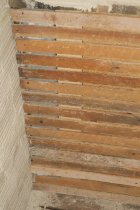
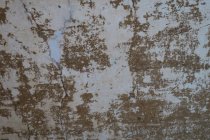
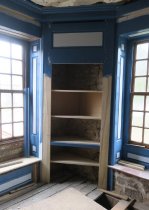
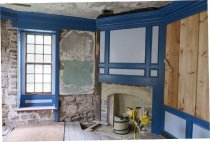
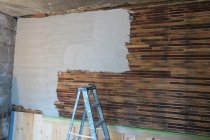
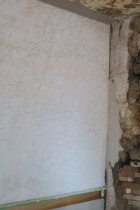
PENNSYLVANIA HISTORICAL AND MUSEUM COMMISSION KEYSTONE HISTORIC PRESERVATION GRANT PROGRAM QUARTERLY STATUS REPORT FORM The Historic Preservation Trust of Berks County, PA., Project ME Number 16709: George Douglass House Restoration Project work accomplished October 1, 2019 to December 31, 2019: During this quarter substantial progress was achieved in first floor parlors, kitchen, and early store room in the categories of interior plasterwork, joinery, and painting with scientifically and precisely determined original colors: INTERIOR PLASTERWORK: For the entire project the primary preservation objective is to retain, stabilize, secure, and whitewash original plasters coatings soundly anchored in original hand-split lath and in a reasonably regular plane, and to re-plaster or re-coat only severely degraded, unstable, or otherwise un-salvageable early plaster. Reasonably intact original plaster will be preserved and exhibited un-coated. 1765 KITCHEN [SE QUADRANT]: Applied lath where necessary and repaired plaster on kitchen walls above and below chair-rail and above fireplace. Applied lath, scratch coat, brown coat to the re-created "bratticed" board partition above the chair rail [Photos # 28 & #9]. Removed lath and re-lathed deteriorated and detached or de-laminating ceiling plaster adjacent to the re-constructed partition; applied scratch and brown coats. Removed lath and applied re-purposed sawn lath to disturbed or compromised section of intersecting hallway wall adjacent to partition. c. 1768-C. 1798 AMITY STORE [SW QUADRANT]: (A) Missing plaster on the three original walls was replaced with a lime plaster "scratch" coat base, and a "brown" coat of lime plaster with an animal hair binder, keyed for a finish coat of lime plaster without additives. More extensive fractures were bridged with a base coat consolidated with a chemically neutral mesh tape and a finish coat. (B) A Structural steel column in the corner of the partition was bridged over with re-purposed sawn lath run into the corner joint with the hallway wall to provide lateral rigidity to the partition [Photo #2]. All stabilized early plaster with discoloring surface accretions in the store will be gently brush-cleaned with water in preparation for lime-based whitewash in 2020. (C) The ceiling is severely compromised by many hairline and open cracks, thin covering over lath, and random detachment and deflection from the ceiling plane; the surviving plaster will be secured and re-aligned in the ceiling plane with recessed plaster washers, and re-coated, after application of mesh tape closure over re-filled open cracks. (D) All wallpaper remnants were removed from ceiling [Photo #2a]; adhesive residue to be reduced as much as feasible without abrasion or chemical cleaning agents or risk to the early plaster sub-strate. CARPENTRY AND JOINERY: Carpentry and joinery work in the 4th quarter focused on milling and fitting the fine paneling, cornice, and moldings preliminarily installed in the NW front ["best"] parlor in the 3d quarter, and preliminary installation of faithfully replicated joined woodwork in the family ["back"] parlor. Original segments of 1765 woodwork survive intact and in-situ in both parlors, providing three-dimensional templates for re-fabrication of replacement components. Each new element in the best parlor is fabricated and molded from an original fragment or complete module in its un-modified construction and molding profile. As determined to be the authentic original colors by consultant Matthew Mosca, Deep Prussian Blue and Moderate-Light Gray colors were applied to panel fields, stiles, rails, and molded architraves and panel transitions [Photos #4, showing replicated wainscot and baseboard on best parlor partition; and Photo # 2b, showing paneling above the fireplace, molded cornice, and wainscot paneling]. Period panel fields in the best parlor were originally decorated with a medium-blue vernacular "marbleizing", some surviving, which will be studied, curated, and replicated by traditional techniques of the period. Photo #14 shows the related fireplace paneling in the back parlor, and the aprons of the chair rail and cornice assembly, also painted in photo-microscopically determined original "Spanish brown" color. Larry Ward |
Date |
January 2020 |
Object Name |
Report |
Catalog Number |
1006.01.053 |
Search Terms |
George Douglass George Douglass House Restoration GDHRPT plaster preservation lime plaster board sub-strate board partition back parlor Spanish brown |
People |
George Douglass |