

Archive Record
Images
![#1: Preserved original [left] and new [right] plasterwork](https://s3.amazonaws.com/pastperfectonline/images/museum_296/006/thumbs/100801084.jpg)
Additional Images [3]
Metadata
Collection |
Sites and Structures Reports |
Archive Number |
HPTSSR39 |
Title |
Sites and Structures Report-GDH, March 31, 2019 |
Description |
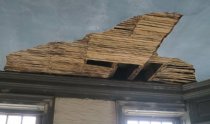
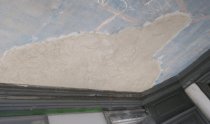
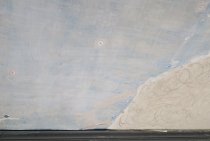
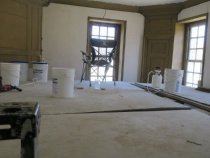
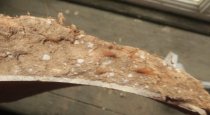
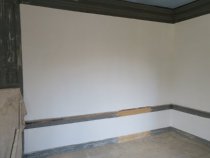
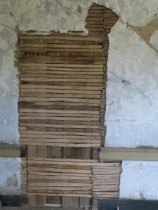
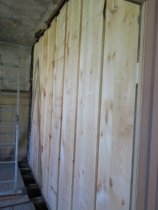
George Douglass House Project work Accomplished January 1, 2019 to March 31, 2019 During the 1st quarter of 2019, our project plasterer (working on his 20th National Register structure) made substantial progress in the interior work, restoring wall integrity and surface finishes in the 2d floor chambers and hallway. This work progressed with the sensitive removal of later coatings and accretions of lime wash, paint, wallpaper adhesives, carbon-soot, and soiling particulates from original finish plaster that was sufficiently stable and well-anchored on the masonry wall substrate to be preserved [Image #1, photo 25, 2/15/19, partially cleaned and preserved wall segment to right of window; new plaster coatings on hall-partition to right of corner]. The original lime-plaster, exposed by this process for the first time in over two centuries, appears to express a soft off-white or light ivory/grey tint, possibly from a small component of local clay, which is a light amber-brown. Under consideration is the application of similarly tinted lime wash to the new plaster finish on walls in the same chamber in order to conform all surfaces to original tonal qualities of surviving intact plaster as much as possible, and to preserve and exhibit historically authentic original surfaces in proximity to new plasterwork. Original surfaces will remain un-coated unless evidence is found for early paint or lime-wash. The large area of missing plaster [Image #2, photo 52, 11/9/18] in the NW chamber ceiling was re-plastered with a scratch-coat lime plaster mix [Image #3, photo 6, 3/14/19] , and a thin finish coat applied after the base coat had adequately set-up. Unstable, de-laminated, and deflected plaster was restored to the proper ceiling-plane with recessed washers where necessary. Missing plaster was replaced with lime plaster base ["scratch"] coatings [Image #4, photo 5, 3/14/19, NW (front) chamber above best parlor, showing plaster washers, large plaster patch]. Paint and other accretions were scraped off early plaster surfaces, which were then washed with clear water and air-dried with the aid of shop heaters that also provided effective curing temperatures. Fractures were filled with base plaster and finish coating after mesh-taping, and feathered to the ambient ceiling-plane [See Image #4]. Platform-scaffolding was erected in each room as work progressed [Image #5, photo# 21, 4/6/19], and the room temperature consistently maintained above 50 degrees F. during the curing ["setting up"] period for applications of plaster. Defective or missing lath was replaced or stabilized in-place. Historically authentic lime plaster was employed for the base and finish coatings, reinforced with animal hair as found in the original 1765 plaster composition [Image #6, photo 54, 1/9/19, fragment of original cove cornice]. Finish-coat plaster was applied to stabilized and replaced lath and base coatings [Image #7, photo 13, 1/24/19, NW (front) chamber. New chair rail, conforming to the surviving 1765 profile, was installed across the closed up doorway to the back (NE) chamber, which had been determined to be not from the pre-Revolution period, restoring the plank partition to its original "blind" configuration, lathed [Image #8, photo 62, 11/9/18] and plastered over. Later-period coatings of paint, wallpaper glue, and fossil-fuel accretions have been removed from several hundred square feet of stable and intact original plasterwork on chamber walls. These wall ranges, fine specimens of pre-Revolutionary War American vernacular craftsmanship, will be preserved as permanent in-situ exhibits demonstrating undisturbed architectural fabric and un-coated original plaster surfaces. A segment of original early lath will remain exposed behind Plexiglas in the NW back-chamber as an exhibit of authentic 1765 hand-hewn lath and hand-wrought "rose-head" nail fasteners [See details and photos in record HPTSSR37, GDH September 30, 2018]. Blind partitions were re-established between 1st floor parlors and between the kitchen and southwestern front ("store") room on the first floor [Image #9, photo # 33, 4/6/19, showing planking ready for lath]. By the end of March, 2019, plaster restoration on the 2d floor of the George Douglass House, both in terms of preservation of original plaster and stabilizing and re-coating compromised segments, had progressed through the majority of plaster walling in the chambers. In addition, 3 of the 4 ceilings had been stabilized, leveled, and re-plastered. All stable original plaster wall segments on 2d floor were restored by removal of non-period coatings and preserving un-compromised plaster on original lath in acceptably uniform plane. Laurence Ward, December 2020 |
Date |
March 31, 2019 |
Object Name |
Report |
Catalog Number |
1008.01.084 |
Search Terms |
Plaster restoration Lime wash brown coat plaster washers mesh-tape ceiling plane Hair binder finish coat curing blind partition plank partition rose head nail Lath exhibit HPTSSR sites and structures lime bits chamber plaster ceiling lath scratch coat |