

Archive Record
Images
Additional Images [1]
Metadata
Collection |
Mouns Jones |
Archive Number |
MJHDWG1 |
Title |
MOUNS JONES HOUSE RUINS{a} DOUGLASSVILLE BERKS COUNTY PENNSYLVANIA |
Description |
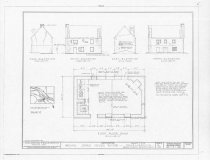
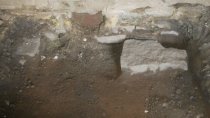
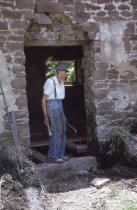
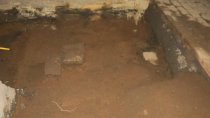
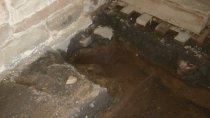
Measured drawings (18 X 24 inches) accompanying Historical American Buildings Survey photographs and text. Two pages of information contain cover page, inset location map, structural plans, and floor plan drawing. Image #1 is of drawings only. For images of cover-page refer to MULTIMEDIA LINKS or additional image. For full HABS text see 1000.01.018--MJTX1 or MULTIMEDIA LINKS. For photographs included in this HABS project file see records MJPH16--1000.01.016 and MJPH17--1000.01.017. See Notes below describing two additional [photo] images. Regarding the relationship between the eaves wall doorway locations and the "former board partition" noted on this drawing, see photo record MJHPH67--1000.01.072. FOOTNOTES: {a} "Ruins", as an architectural term informing the condition of significant historic structures, usually signifies the remains of a building or other structure which has completely or substantially collapsed, survives with significantly diminished structural integrity, or has been thoroughly demolished. As discussed below, the use of "ruins" in describing the formal and structural condition of the Mouns Jones house after the 1950s partial collapse is an exaggeration which inadequately acknowledges the substantial extent of original masonry fabric still standing and structurally stable after the roofing and flooring failed and fell onto and demolished the first floor. The standing "critical mass" of early walling [most probably 80-90%, of the two-story perimeter masonry survived the partial collapse); see record photos in MJHPH67, Image ## 8 & 9, and MJHPH16, Image # 1], and the entire foundation plinth and basement{b}, delineated the original perimeter of the floor plan and provided clear guidance for the restoration of the house. An early bake-oven foundation was also unearthed and re-used to support the re-created oven shown on the drawings by Barry Stover published on sheet 2A of the Atlas of Architectural Drawings published by the Trust in 2008. John Ruskin and other Victorian preservationists, and some of his American disciples in the early 20th century, espoused the stabilization and conservation of "noble ruins" in their as-found condition. The Historic Preservation trust of Berks County adopted the more progressive American approach, choosing to consolidate and restore early fabric, re-construct missing or altered elements, and re-create other documented segments and components to complete a substantially authentic building in its early form, as determined by sufficiently persuasive evidence and analysis. This approach requires careful documentation of the process, detailing each phase of the project and the means, methods, and materials utilized; detailed interpretation of the basis of the restoration approach; and full disclosure of changes and non-period additions to the fabric during the process of "restoration". The late 1940s, 50s, and early 1960s photographs [see archive records MJHPH3, 16, 17 (showing loss of upper walling from SE gable end), 44, 66, 67 (images #1, 7 & 8), and 84] show that the Mouns Jones house roof had collapsed, destroying the integrity of the attic and second floor joists and boarding, and the roof framing, wall plates, and roof covering material. These photographs, and earlier images [MJHPH60, Images #1, 3 & 5] document that the roof had been neglected and had leaked for years, causing the ultimate deterioration of structural framing members and eventually the failure recorded in these drawings and in the photographic records. As is evident in these drawings and in contemporary photographs cited above, the vast majority of the masonry walls, original and replacement fenestration in the first and second stories, both chimneys, door framing in both eaves walls [one relocated], the long joist {d} leveling plate above the existing first floor doorway and windows [photo], and all four reciprocally bonded ["quoin"] corner piers remained substantially intact. Considering the above facts and findings, one might question the use of "Ruins", in its classical and Ruskinian sense, as well as in a modern context, in describing the Mouns Jones house in 1957 and when placed in the custody of the Trust in 1964-5. This remaining structural fabric, including considerable masonry evidence of the early elevation details, fenestration geometry, and interior plan-form, provided a sound basis and sufficient documentation for stabilizing and reconstructing this important dwelling on the frontier of Philadelphia in the early decades of the eighteenth century. {b} the partially below and above-grade foundation walling which sometimes{c}encloses "cellar" spaces below the first (ground or above-grade) floor and serves as a perimeter "base" for the superstructure. Renaissance Pallazzi often had "rusticated" [scored to resemble squared and dressed ("ashlar") stonework]- basements rising prominently above-grade and supporting the "piano nobile" [principal story] and attic spaces; see George Douglass records and photographs for a provincial ashlar "principal" story [first floor] set on a rubble basement enclosing partitioned cellars. {c} No evidence has been found for a cellar below the first floor of the 1716 house. HABS notation regarding a cellar "filled-in" by debris from the collapsed roof, flooring, and framing timbers is attributable to a mistaken assumption that a sub-grade basement enclosed a cellar. Archaeological probing disclosed that a rod inserted at 45 degrees penetrated through the sub-grade space that would have been occupied by cellar walls. Probing and interior excavation revealed that the stone foundation extended only about 2 feet below grade. Later excavations by PA Society for Archaeology Chapter 21 uneartherd.bed-stones aligned across the earthen sub-strate, to support first floor joists [see attached photos 7748, 4670, 53, and 11, the last of which also shows the bed-stones set on undisturbed amber colored alluvial clay]. The bearing surface of the "pier" stones was 9 ¼" below the level of the kitchen fireplace hearth, exactly the amount of vertical space required for 8" joists and 5/4" floor boards. Photo #64 is a late 1960s depiction of restoration carpenter Robert Landis standing in the NE doorway of the House during structural restoration. The photo seems to show 2 floor joists, but does not clearly show whether they are set on bed-stones or are suspended above a cellar. This evidence cumulatively precludes the inference of an open cellar under the first floor of the Mouns Jones House. {d} The HABS drawing included in this record notes: "Second Floor Joists 5" x 8", Edge Beaded, at 3'-0" On Center." No joists were found after the 1965-70 restoration campaign; however, this HABS note, combined with 1960s photos showing beaded joists in-situ near the kitchen fireplace, afford a reasonable basis to infer that the joists were sawn, planed, and beaded rather than roughly squared and hewn. Laurence Ward, March, 2016; updated August, 2023. |
Date |
1957 |
Object Name |
Drawing, Architectural |
Catalog Number |
1000.01.019 |
Search Terms |
MJDWG Mouns Jones Drawing Mouns Jones House HABS Historic American Buildings Survey Library of Congress Old Swede's House MJHDWG Mouns Jones House Drawing HABS Drawings Elevation Drawing Board Partition Partition Wall Floor Plan Joist plate Leveling plate Ruins Basement Cellar Sawn joist Hewn Joist Bed Stones |
Creator |
N.M. Souder |
People |
Jones, Mouns Souder, N.M. |
Notes |
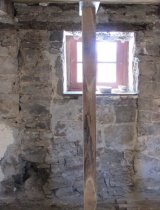
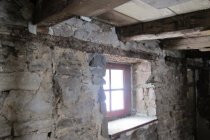
(IMAGES NOTES) IMAGE#2 Detail of exposed masonry joints of original 1716 doorway; IMAGE#3 Detail of original (1716) timber leveling plate for joists which supported second-floor boards; NOTE the slightly higher (and not supported directly on the original embedded plate) position of the joists installed during the 1965-70 restoration," |
Notes on Related Objects |
OBJECT ID# - 1000.01.092 or MJHPH86, caption complete is ""West eaves wall and openings after pre- 1958 roof collapse." This photograph shows visual evidence of the "Mouns Jones House Ruins." |