

Archive Record
Images
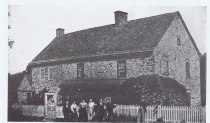
![#2, 6740-Exterior ["extrados"] of Keim root cellar vault](https://s3.amazonaws.com/pastperfectonline/images/museum_296/005/thumbs/100801051-3.jpg)
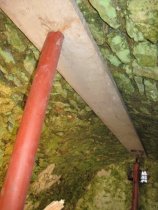
![#3, 4329-Interior ["intrados"] of Keim root cellar vault](https://s3.amazonaws.com/pastperfectonline/images/museum_296/005/thumbs/100801051.jpg)
Additional Images [12]
Metadata
Collection |
Sites and Structures Reports |
Archive Number |
HPTSSR6 |
Title |
Sites and Structures Report, November 2011 |
Description |
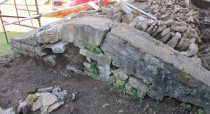
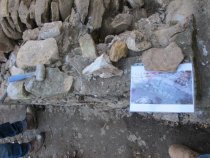
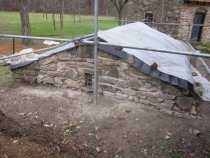
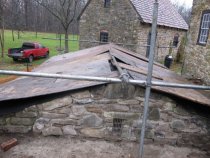
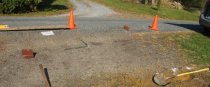
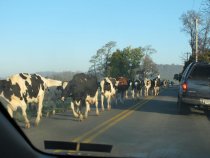
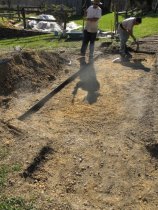
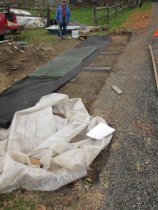
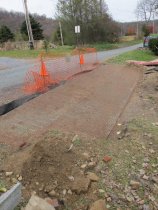
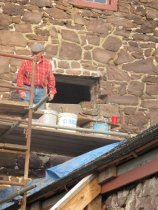
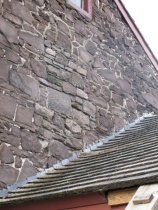
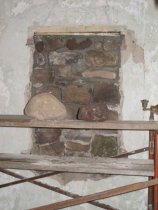
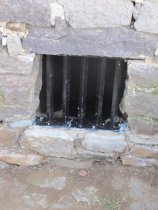
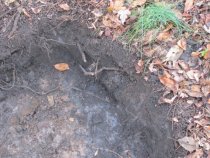
Sites & Structures Report for the November 30, 2011 meeting of the Board of Directors of the Historic Preservation Trust of Berks County Description The following is a summary of preservation and restoration work completed and in-progress, with recommended Board action: Keim House: A. Root Cellar stabilization and restoration: The barrel-vaulted root cellar, in current form a "ground cellar" east of the gable wall of the federal-era addition to the original house, had been covered with topsoil and grass after removal of the small gabled structure shown in Image #1, an 1897 photo, #13, 10/6/10 [reputedly a bake house but no evidence of a fireplace has been found]. Image #2, Photo #6740, shows the exposed exterior ["extrados"] of the vault; the Board might want to consider providing a sheltering structure, allowing exhibition of this traditional (but seldom seen) architectural element. The century-long exposure to the elements eventually resulted in leaks, mortar disintegration, and dislodged stones in the interior ceiling ["intrados" or "soffit"] of the vault. Numerous fallen stones were on the vault floor when the project began [Image #3, photo #4329]. Image #4, Photo #6936 is a partially restored view showing re-mortared joints and a plank supported on posts functioning as a centering-shore stabilizing the crown of the vault during restoration. The above-grade north gable stonework of the root cellar had been re-worked more than a century ago in connection with the removal of the upper story, using brick piers flanking the vent [reduced in size from the original jamb system, which was probably of stone]. The reconstructed upper gable had become unstable and fractured in several places [Image #5, photo #6743]. Image #6, Photo #6775 was used as a guide to re-set most of the stones in substantially the same location as they occupied before their dismantling. Image #7, Photo #6915 is a restored view of this wall segment. Image #8, Photo #6944 shows the vaulted structure roofed for winter with fiberglass insulating batts, rubber matting, plywood sheets, and a waterproof tarp. If the Board approves, this covering should be replaced by a permanent exhibit-shelter in 2012, now completed. B. Driveway Stabilizaton: The steep drop from the incrementally raised pavement of Boyer Rd to the Keim driveway has for many years been an impediment and a wet-weather hazard to entering and exiting vehicles [Image #9, photo 6803]. Image #10, Photo 6734, is a typical morning traffic jam on the Lobachsville by-pass. The depressed area adjacent to the road was excavated and a steel retainer plate installed [Image #11, photo 6810]. The base of the 8 foot by 25 foot excavation was aligned to provide a finished ramp elevation which would meet the road-bed at a moderated constant slope. Steel plates were positioned under the joints between the sand-cast fiberglass grate-panels forming the ramp to the road paving [Image #12, Photo 6840, also showing the geo-textile underlayment which will prevent settlement-loss of the aggregate fill material from the open cells of the grates]. Image #13, Photo 6903 shows the finished installation, which now includes the loose-stone transition provided by Pike Township at its cost. The Township paved the transition strip in the spring of 2012, also at its cost. George Douglass House: Store addition: The non-period second floor window in the south gable wall has been closed-up [Image #14, photos #7042, in-progress, and Images 15 & 16, Photos #7048 & 7051, after completion of in-fill]. Work has begun on closing up the first floor [west bay] window which was inserted after 1930. The jambs of both openings were modified by removal of some stones to allow the mason to weave the new stonework into the exterior segment of the wall without delineating the outline of the windows, which were not original to the store structure. DeTurk Multi-Function building: The mason has restored the stone sill in the opening for the root cellar vent in the west foundation wall, and installed the replacement steel grille fabricated by blacksmith James Kieffer [Image #17, photo #6940]. The original grille was wrought iron, similar to the surviving grille in the east end-wall of the vault. Douglass, Douglass-Jenkins and "Amity" Store Ledgers; and Brinton fragmentary Civil War paymaster records: Jon will catalog each ledger and day-book for the archives. The Board discussed the need for a secure, accessible, and environmentally appropriate location for these primary records. Hilary and Michelle had suggested the HSBC, which would accept them as a collection on an annually-renewable long-term loan, providing: (a)The Trust would provide archival storage materials [box, etc.]; (b)The Trust would be authorized to remove the books for research, events, etc. on reasonable notice, and return them if requested by a researcher who would use them at HSBC. (c) We should consider insurance, photograph and archive important and identifying portions of these records, and consider exhibiting them at future events, such as an interpretive demonstration of the store operation in the period covered by the Day-Books and ledgers. Specified ledgers and account books were subsequently delivered to HSBC under this arrangement. The Civil War ledgers and pay roster are not within the Trust's mission, and relate to units from all states in the Union. We also have a few of Brinton's order-books, which had been stored in the GDH attic for decades and are now kept at WH. See requested action #2. Paint Analysis: I have forwarded Matthew Mosca's report and recommendations to all Directors. If you did not receive it, there is a paper copy in the Trust's office at WH. This process has given us authentic historic colors for most of the wood finishes sampled. The Board should eventually adopt a policy regarding the appropriate paint treatment where the woodwork was originally unpainted, as well as those instances where our consultant has determined the color of the original finish. The third variant in the paint matter is the chair rail in MFH, which appears from paint analysis to be an alteration in the first third of the 19th century, probably after the death of Michael Fulp. This decision will include consideration of the option to remove the chair rail as a non-original element, or paint it the earliest color found in MM's analysis. Morlatton Parking Lot: Test pits have been dug at several places in Phase I of the revised plan. The results were encouraging: 10-12" below the surface of the heavily root-matted and coal-silted soil layer is a firm bed of dense clay, an excellent bearing material for the stone parking area [Image #18, photo #7076]. This clay formation has been found to provide solid support for the foundations of the Trust's river-zone buildings. The relatively soft root-matted layer, not suitable as a base for a mixed stone top-dressing and parking surface, will be removed to avoid de-stabilization and settlement from organic decay and compression. Because the proposed parking surface composed of 2A-modified stone will be in the flood-plain and will closely conform to the elevations of the existing grade, a three-sided perimeter containment system will be necessary to avoid having the stones carried downstream [or "onshore"] by a flood, or displaced by vehicles from the parking surface. I will bring to the meeting a sketch of the system I propose, which is designed to produce a well-anchored submersible log perimeter which will not float. We propose to use locust logs from the trees cut from the parking areas, preserving healthy, mature, and non-threatening trees wherever possible. The anchors counteracting the buoyancy of the logs would be grates or rigid panels set on the clay sub-base, bolted to the logs, and weighted-down by the considerable stone mass forming the base and top courses of the parking area and the drainage courses outside the perimeter [See discussion and photos in record HPTSSR7]. The drainage system consists essentially of the permeable base-stone layer allowing storm accumulations to pass under the parking areas into the drainage courses and to the detention ponds at a slightly lower elevation outside the parking perimeter, eventually percolating through the soils to the river, diminished marginally by evaporation. Drainage-course pipes will be placed under intersecting gravel driveways and pedestrian trails. Michael Fulp House: Plaster patching will be completed this week. The "surplus" architectural elements considered as possibly disposable are assembled in the first floor for inspection and decision. Requested Board action: 1. consider providing a sheltering structure for the KH root cellar to preserve and exhibit it as a study-piece, after S&S committee consideration and recommendation of form and details. 2.Consider Jim and Phil's suggestion to donate Brinton civil war records and order books to the Army Heritage Museum in Carlisle. Jim has the contact information. 3.Procure and/or designate storage space for mission-related items to be removed from exhibit and interpreted spaces. 4.Dispose of non mission-related and non-usable architectural items, such as shutters, window sash [after removal of period glass], doors, etc., in conformity with policy adopted by the Board; 5.Authorize the preparation of drawings [funded by grant sources] for the proposed KH pent roof and cellar-entry structures. 6.Authorize the preparation of drawings [funded by grant sources] for the proposed GDH floor-framing system. The committee consensus seems to be to retain miscellaneous iron hinges and floor boards. 5. Authorize delivery of Douglass/Douglass-Jenkins/ and Amity store record books to HSBC subject to long-term loan agreement. NOTE: All of the above requested items were approved by the Board. Submitted by the Sites & Structures Committee, Laurence Ward, updated September, 2016, October 2016 and November, 2020. |
Date |
November 2011 |
Object Name |
REPORT |
Catalog Number |
1008.01.051 |
Search Terms |
HPTSSR sites and structures committee report barrel vault ground cellar soffit centering paint analysis parking area log perimeter buoyancy Store ledgers root cellar driveway ramp extrados intrados traction grate geo-textile bed-plates clay bed top dressing |