

Archive Record
Images
Metadata
Collection |
Michael Fulp House |
Archive Number |
MFHFN5 |
Title |
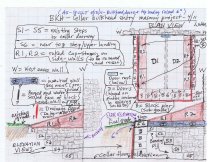
Bulkhead entry waterproofing plans |
Description |
As built drawing of April, 2011 masonry project to stabilize and waterproof the cellar "bulkhead"{1} entry at the Michael Fulp (Bridge Keeper's) House. For several years prior to this reconstruction project, rainfall of ½-inch or more within a 24 hour period would produce several inches of water (occasionally 6-8 inches or more) on the cellar floor of the Fulp house. It was evident that the bulk of the incursion was from 2 sources 1) ground runoff ["sheet-flow"] cascading down the cellar stairs and 2) percolation through saturated soils and permeable fill layers built up as the river bank and alluvial plane were raised to mitigate periodic flooding. Most of this accumulation was the result of the lack of a moisture barrier outside the flank walls ["cheeks"] and a permeable support bed [a loose mixture of clay, gravel, and loam riddled with coal particles deposited during river flooding] under the top stone step. Although the pre-historic clay bed is excellent bearing material, the grade-raising alterations compromised the stability of the clay. There were no discernible "footing" stones to distribute and stabilize the masonry loads imposed by the cellar entry structure. This "bulkhead", situated in a shallow grade-basin, was a virtual "funnel" for pooled ground water, augmented by runoff from the roof above the bulkhead. The remediation plan consisted of three elements: A. Raising the entire bulkhead entry structure 6 inches above pre-existing levels, and adding a granite stone slab landing ["S6" in drawing, 65 inches long, 18 inches wide], which varies in thickness from 6 inches at the riser to 11 inches at its outer face above the previous level of the top step ["S1"] of the descending staircase. This massive stone was "man-handled" into position with rollers and digging bars. It will dam much of the ground-surface runoff which previously flowed down the cellar steps. B. Laying up a continuous perimeter wall of concrete block to support and buttress the flank walls, the raking cap stones ["coping"], the shoulder-walls abutting the flanks, and the added upper landing stone. The outer face of the sub-grade block wall was pargeted with mortar, which was brush-coated with a conventional waterproofing fluid; the interface between the coatings and abutting soils was lined with overlapping sheets of "dimpled" drainage board [Delta-Drain] with an adhering filter-fabric [the same "geotextile"-lined moisture barrier which was installed on the exterior face of the foundation walling of the entire building]. The lower portion of this impervious sheet material was folded 90 degrees and extended outward across the excavation floor in order to direct the down-flow through the dimpled exterior plane of the sheet and away from the base of the block wall and its "lean concrete"{2} footing pad. Water collected by this gravitational conduction system will flow into the perimeter drains around the foundation walls and footings [see MFR10FN2--1005.01.058] to a remote discharge. C. Fabricating and installing board-and-batten ["ledged"] doors "double-hung" on "pintles"{3} driven into the mortised raking cap stones on the cheeks. The coping now sits 6" higher than its pre-restoration elevations, presenting an improved water barrier along the flanks of the entry structure. After this process was completed, much less water accumulated on the cellar floor after substantial rainfall in the region. Future river-flood incursions will be mitigated with a pumping schedule. FOOTNOTES {1} a term which apparently emerged in the building trades in the mid-19th century, probably in New England. The word "bulkhead", sometimes called a "cellar cap" in 18th century documents [Lounsbury], does not appear either in the 1786 Philadelphia Carpenter's Company "Rules" or in the 1797 Chester County "Practical Carpenter's Guide" in their respective treatments of "cellar doors." The Philadelphia "Rules" describes and prices only wooden "cheeks" and "sills" from "scantling" [dimensioned lumber]. The 1797 Chester County "Guide" provides for the less expensive option of stone for these elements, as well as "sawed scantling." Roughly vertical mortar joints between the stone cheeks and the foundation walls indicate a later date for this addition. {2} relatively dry ["stiff"] mortar hardened with clean "2B" stone. {3} The term "pintle" is significantly later than the 18th century descriptor "hook", which was often used in conjunctive forms such as "hook-and-eye", "hook-and-hinge", and "hook-and-strap [hinge]". Larry Ward |
Date |
05/13/2011 |
Object Name |
Field Notes |
Catalog Number |
1005.01.065 |
Search Terms |
Foundation Waterproofing Geotextile Filter Fabric MFR10 As-built Bulkhead Entry Flank Walls Landing Stone Drainage Board Bulkhead Entry Cheeks Coping Lean Concrete Ledged Hook Pintle Cellar Cap Scantling Cellar doors Cellarway |
Creator |
Ward, Laurence |
People |
Michael Fulp |