

Archive Record
Images
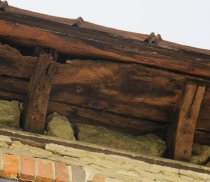
![#3, photo 21: Failing undersized joist [left] and beaded replacement [right](https://s3.amazonaws.com/pastperfectonline/images/museum_296/006/thumbs/100801074-3.jpg)
Additional Images [7]
Metadata
Collection |
Sites and Structures Reports |
Archive Number |
HPTSSR30 |
Title |
Sites and Structures Report November 2016 |
Description |
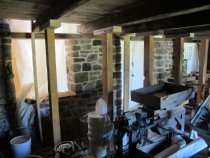
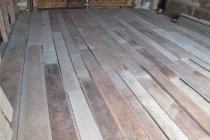
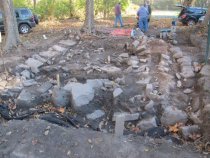
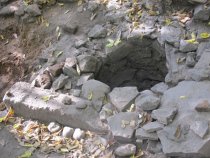
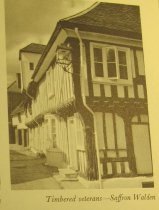
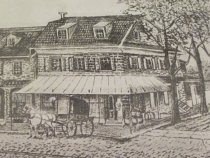
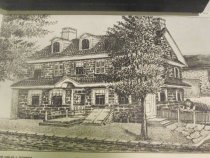
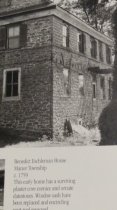
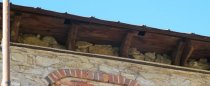
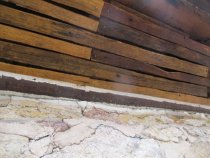
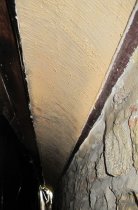
I.MOUNS JONES HOUSE RESTORATION: During the late summer and early autumn of this year, the riverside wall of the Mouns Jones house was re-constructed from the foundation level to the timber plate [Image #1, photo 4, 10/10/16], which will bear the pocketed ends of the joists supporting the 2d story floor boards donated by the late Dr. Donald and Esther Shelley [Image #2, photo 41, 5/9/16, boards laid out on barn floor in Mouns Jones house floor dimensions]. The two-plank lap-joined 18 foot "leveling" plate also serves as the continuous lintel spanning the re-centered doorway and the two restored window openings in the first story wall-bays. The Lainhoffs are seeking old white oak timbers of the appropriate dimensions [5" by 8" x 18 ft.] to serve as joists, in replacement of the undersized "ceiling beams" donated for the 1960s restoration. [Barn beams were later acquired, re-sawn and beaded, providing the required number of joists for the 2d floor: Image #3, photo 21, 8/7/18, showing the beaded replacement joist (right) and the earlier undersized, compromised, and deflected joist to its left, as re-purposed from a log house and installed during the 1960s restoration]. II.II.Archaeology: The volunteer archaeologists from Chapter 21 of the Pennsylvania Society for Archaeology have unearthed two highly significant features near the northwestern gable wall of Mouns Jones House: A.The partially collapsed remains of a barrel-vaulted root cellar [Image #4, photo 27, 11/5/16]; B.A buttressed small-diameter, roughly coursed well adjacent to the northern end-wall of the root cellar [Image #5, photo photo 14, 10/19/16]. Both of these below-grade structures will be carefully investigated at all accessible levels and the unearthed artifacts documented, catalogued, and stored for future analysis. III.KEIM HOUSE COVE CORNICE RESTORATION: Early photographic evidence shows what appears to be a plastered "cove" cornice on the southern eaves wall of the 1753 Keim House in Pike Township. This feature derives from 17th century English antecedents [e.g., Image #6, photo 5886, 11/24/13] and appears on several examples of "Pennsylvania-Georgian" houses constructed in Germantown in the 1740s and 50s [Image #7, (de la Plaine House), Photo 30, Aug, 2013; Image #8, Weygandt House, 12/8/20; and Image #9, Photo 4657, 10/2/13, Benedict Eschelman house, Manor Township, Lancaster County. Removal of the 19th century "box" cornice from the south elevation exposed the original concave ends of the attic floor joists penetrated with nail holes for fastening early lath [Images #10, Photo 20, 10/24/16 and #11, Photo 4140, 9/11/13]. These findings and the early photograph confirmed and documented the coved form of the original plastered radial transition, upward and outward, from the bed molding atop the stone wall to the fascia-board terminus of the roof framing. Old hand-split lath was nailed to the curved joist-ends [Image #12, photo 11, 11/1/16], and the first ["brown"] textured coat of plaster was applied on November 1st [Image #13, photo 10, 11/11/16]. The next coating of plaster will be incised ["scratched"] to provide better "keyed" anchorage for the finish coat. Submitted by Laurence Ward for The Sites & Structures Committee; updated, December, 2020 |
Date |
November 2016 |
Object Name |
Report |
Catalog Number |
1008.01.074 |
Search Terms |
Blind partition stops Joinery brown coat scratch coat finish coat uncoated plaster HPTSSR sites and structures Corner cupboard Partition lath Shelf ghosts Wainscot panel |