

Archive Record
Images
Metadata
Collection |
Sites and Structures Reports |
Archive Number |
HPTSSR31 |
Title |
Sites and Structures Report November 2017 |
Description |
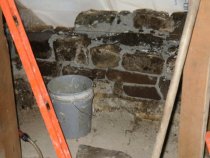
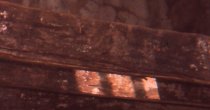
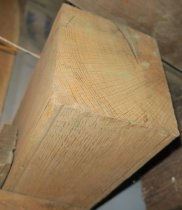
HPTSSR November, 2017 1.Mouns Jones House: A.Wall restoration; mortar selection: Re-laying of the failing masonry pier south of the re-centered doorway began this month [first few courses, Image #1, photo 13, 11/7/17] and then was suspended because of weather too cold for reliable curing of new mortar. The masonry technique includes bond-stones transverse to the long axis of the walls and piers to produce a more stable and durable wall structure. A dolomitic mortar [relatively high in magnesium content] was specified for beds and joints based on qualitative analysis of early mortar from the attic-interior of the north gable wall. The test-mortar was selected for its proportions of calcium, magnesium and silica, which proved to be very close to dolomitic limestone sources in adjacent Earl and Douglass Townships, particularly one quarry quite near the northern boundary of Mouns Jones’s tract, according to a published 1883 Pennsylvania Geological Survey report. Most of the limestone north of the sandstone formation along the Schuylkill River, which extends several miles northward into the Oley Valley, tends to be high in calcium and significantly lower in magnesium than the early Mouns Jones House mortar. Such mortar composition would be historically inauthentic for use in the Mouns Hones House. A custom-mixed dolomitic mortar was located and selected for the restoration based on its remarkable chemical similarity to the early lime mortar found in the walls and its elemental similarity to the limestone from the nearby quarry. The formulations of the old mortar from the house, the mortar selected for completion of the project, and the nearby quarry source were all within a few percentage points of each other as to all significant ingredients [see record #MJHTX12 for a more detailed discussion of the geological, technical, and historical aspects of this mortar analysis]. B.Joist treatment: (1) Photos/slides suggesting hewn surfaces for the 2d floor joists are inconclusive; close examination of other 1964 slides and sunlight angle in the photos indicates a short-radius "edge" bead with "quirked" groove above a segmental bead in joists closest to hall/kitchen fireplace; the form, deterioration, and deformation imply an early date; Image #2, photo 47, 10/20/17, showing deteriorated edge-beads and incised "quirks" on the lower corners of 2 early joists after collapse of the Mouns Jones roof, c. 1957. (2) current committee recommendation: planed and edge-beaded joists as indicated in 1964 slide-images; this interpretation is consistent with HABS "edge-bead" note on 1957 drawing, which suggests groove only on vertical faces above the bead, consistent with 1964 photos; the HABS note also provides 5" x 8" joist dimensions. Photos also provide scale for sizing bead and quirked groove; (3) Hewn joists in parlor space in the 1960s photos are possibly replacements necessitated by 19th structural damage to SW corner or other masonry reconstruction requiring joist replacement; this un-molded type will not be replicated in view of the 1964 photographic evidence of beads and the concurring HABS note describing what they saw ["edge-beads"] in 1957, shortly after the roof and flooring collapse; edge-beads are therefore recommended for parlor joists as well as hall/kitchen "ceiling beams", consistently with traditional room hierarchy and vernacular decor in early "back-country" settlements. Image #3, photo 13, 11/13/17 shows a sample beaded and quirked replacement joist, sized, planed, and molded by Chris Lainhoff. 2.Morlatton Village Pathways: Drawings of proposed pathways, with stone retaining borders, to each building and to the Thun Trail east of the George Douglass House have been filed with Amity Township; awaiting response to "sidewalk" permit application [not required for MJH or MFH because not on Township roads]. 3.George Douglass House projects grants: A.Plans and Specs have been submitted for PHMC review and approval, after which we will begin prep and preliminary work, including millwork at Lainhoffs shop: floor joist consolidation, fabrication of panel templates, moulding samples, lath, and floor-board layout, and evaluation of plasterwork to be consolidated and preserved or replaced; X-ray element testing indicates high-calcium wall plaster; cornice plaster test pending; B.Required Project-sign is in production at local sign-maker. 4.White Horse Tavern window restoration: two front window frames have been consolidated and sash restored and glazed; the restored frames, new sills, and sash were re-installed last month; the white paint undercoat is brighter than the lead-free "lead white" finish paint that will be applied next spring. Because of the risk of mildew/mold to a linseed oil finish, we will not paint until then. Un-mortared spaces between frames and masonry will be insulated during winter. 5.Keim Farmstead Buildings: A. Wood Turner’s shop building: Based on possible new source of funding [if received], we recommend that J. Bowie and R. Ortega be re-engaged under their proposal to prepare an analysis and recommend a program to stabilize the displaced roof framing and flooring if funding is sufficient. B. Obtain diagnosis and remediation for two chimneys on house and addition; matching funds needed. Laurence Ward, December 2020 |
Date |
November 2017 |
Object Name |
Report |
Catalog Number |
1008.01.075 |
Search Terms |
HPTSSR sites and structures dolomitic mortar Geological Survey quarry joist bead quirk hewn edge-bead paths pathways lead white paint mortar |