

Archive Record
Images
Metadata
Collection |
Sites and Structures Reports |
Archive Number |
HPTSSR12 |
Title |
Sites and Structures Report, June 2012 |
Description |
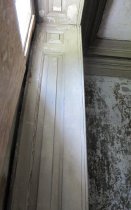
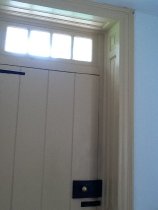
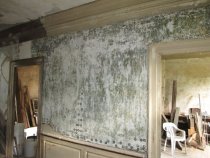
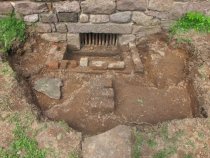
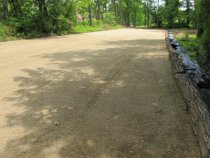
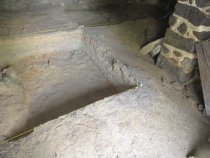
Sites & Structures Report for the June 27, 2012 meeting of the Board of the Directors of the Historic Preservation Trust of Berks County Description: The following is a summary of preservation and restoration work planned, completed, and in-progress, including requested Board action on pending projects and collections management: George Douglass House: A. Front Door, 1765 house: Upper section of the original northern jamb of the raised-panel doorway surround is shown in Image #1, photo #8724 attached. The long vertical panel of each jamb extends above the top of the door opening to the bottom rail of the square panel-blocks flanking the top segment of the transom. Thus the stiles, rails and panels on the interior facing of a paneled door would not have been level or symmetrical with the corresponding elements of the existing paneled jamb. The panels on the jambs would not "reflect" the panels in the door in the same elevation ranges. Any perspective view of a recessed paneled door with a non-aligned paneled surround would distort the three dimensional symmetry in a door and doorway intended to be viewed as a coordinated design element. This suggests{a} that the interior lining of the Douglass door was not paneled. {a}Not all design and constructive detail decisions followed academic axioms or consensus ideas regarding the "correct" method of assembling elements in an interior elevation or architectural element. The asymmetry of the panel arrangement can be explained essentially as a vernacular or "rural" solution, not necessarily aligned with Renaissance, "Georgian", "Palladian" or other iconic and architectonic concepts. The locations of the four "pintle" [more commonly "hook" in the 18th century] mortises in the northern stile of the door frame, including two straddling the projections of the horizontal plane where the two leaves would meet, indicate that the original door was a two-leaf "Dutch" door, "single-hung" with one leaf above the other and both hung on the same stile of the frame. This pintle arrangement also demonstrates that the two leaves of the door were not "double-hung" in side-by-side "meeting-house" fashion as at Pottsgrove and other earlier and less vernacular Pennsylvania-Georgian houses in the region. Nor is there any evidence that the upper leaf was split or hinged vertically with pintles on both stiles for independent operation. Eliminating from consideration a paneled interior lining for the door, and dismissing diagonal sheathing or a "chevron" pattern as equally incompatible with a paneled surround, the most compelling treatment for the door interior would seem to be a "common" lining{b} consisting of beaded vertical boards. Such a vertically-sheathed Dutch door would be readily accommodated by the original rabbet [channel] in the surviving segments of the original oak frame. {b} see 1786 Rule Book of the Carpenter's Company (1971 ed., Introd. and Annotations by Charles E. Peterson, p. 20 ("six paneled doors, lined as common", priced). Image #2 shows an example, similar to the Douglass House configuration, of the combination of a paneled surround and vertical-board door lining as it appears in the c. 1770 Isaac Potts house [Washington's headquarters] at Valley Forge. The surround is original but the door is a reconstruction. Isaac Potts was the son of John Potts, whose Potts Grove mansion [c. 1752-54] is a possible source of influence for some of the details in George Douglass's less academic house. B. 1765 Center Passage ["Hallway"]: Stabilization and re-alignment of original woodwork, including flooring, cornice, paneled wainscot, doorway surround, turned elements, and baseboards is progressing toward completion [see record #HPTSSR11]. Plasterwork has been consolidated, voids re-plastered and the plaster walls sanded [Image #3, photo 8743]. The passageway woodwork, plaster walls, staircase, and balustrade should be substantially restored and safely accessible by the date of the Fall tour. C. Paint Colors For Center Passageway and Staircase: Paint samples have been prepared for matching with the original colors determined from samples taken and analyzed by Matthew Mosca. D. Cellar Vent Well: Excavation along the foundation of the SW (back) eaves wall north of the doorway revealed a cellar vent protected by iron bars and shielded from ground water by a brick well, which appears to be later than the original construction of the house [Image #4, photo #8705]. The brick enclosure was probably erected when the grade was raised along the front wall; it is not founded on a stone base or any other type of footing. It is recommended that a stone "well" be constructed of random rubble masonry similar to the installation at the vent opening north of the doorway in the NE [rear] eaves wall. The footing system would consist of transverse base-stones set on a coarse-mortar "crust" laid onto a compacted clay sub-strate. Keim House root-cellar vault shelter: It is projected that a preliminary concept plan will be submitted to the Board at its July meeting. Morlatton Village Parking Areas: The modified 2A stone has been spread, compacted, and rolled to the final surface grade and Phase I is now in use. [Images #5, Photo 8773, 6/8/12]. Work is expected to start on Phases 2 & 3 in early July. The S&S committee will confer with the signage committee to coordinate planning for directional and regulatory signs for the parking sites and to develop a comprehensive signage plan for submission to The Schuylkill Greenway representatives and Amity Township for approval. DeTurk House Archaeology: Excavation of four 5' x 5' units have been started in the ground-level kitchen doorway range of the south eaves wall to determine original and subsequent elevations and the composition of the brick-paved floor and hearth stones, and to locate and catalog artifacts found in the fill layers. Image #6, Photo #8887 shows current conditions, with one unit excavated. Few significant artifacts have been discovered, suggesting the probability that the soil-layers represent intermittent filling and compacting designed to mitigate creek flooding and the rising water table. Deeper strata should produce earlier artifacts and expose hearth-stones reflecting the periods and cultural aspects of the occupancy and uses of the varied "plantation" functions of the This small and iconic vernacular "ancillary" structure included: a cellar farmstead kitchen with a large linteled fireplace; a vaulted food-storage ["root"] cellar; a one-room "Grossmutter's" residence; and an attic granary. Requested Board Action: 1. Approval of a concept plan for the primary doorway. 2. Approval of applying the established original paint colors to the passageway woodwork, staircase, balustrade, and paneled wainscot. 3. Approval of a concept plan for the window/vent well. 4. Approval of a collections management plan outline, including disposal of non-mission items, and limiting stored materials to designated spaces . 5. Authority for a signage plan for parking areas and their perimeter. Submitted, Sites & Structures Committee, Laurence Ward, Chair; Updated, November. 2016 and November, 2020. |
Date |
June 2012 |
Object Name |
REPORT |
Catalog Number |
1008.01.057 |
Search Terms |
HPTSSR sites and structures committee report pintle paneled door door jamb Dutch door stile rail common-lined door Doorway surround wainscot vent well Barred casement Mortar crust Sub-strate Clay base Compacted clay |