

Archive Record
Images
Metadata
Collection |
Sites and Structures Reports |
Archive Number |
HPTSSR41 |
Title |
Sites and Structures Report GDH, September 30, 2019 |
Description |
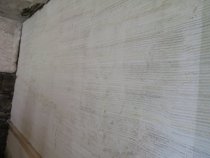
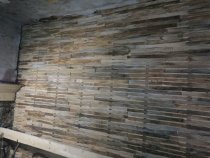
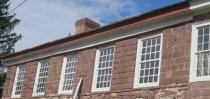
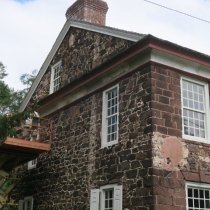
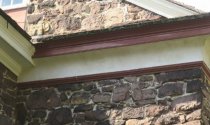
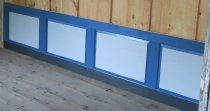
I.PLASTERWORK: Interior: During the 3d quarter of 2019, the project plasterer, William Smith of Brandywine Historic Services, made substantial progress in the interior work, including restoration of wall and ceiling integrity in the 1st floor kitchen. Specific accomplishments include: (A) Determining which original 1765 plaster ranges are soundly anchored in original hand-split lath and in a reasonably regular plane; these plaster segments will be preserved in-place ["in-situ"] and not re-coated with new plaster; (B) Raking out and infilling significantly cracked plaster, aligning the margins into the surrounding original surface, all work very lightly textured only by traditional trowel-tooling sufficient to meet the ambient wall-plane. (C) Deteriorated, de-laminated, and deflected plaster was restored to the proper ceiling-plane in the kitchen with recessed washers where necessary. (D) Missing plaster was infilled with a lime plaster "scratch" coat base [Image #1, Photo # 7, 7/2619-kitchen partition], a "brown" coating of lime plaster with an animal hair binder, keyed for a finish coat of lime plaster without additives or tint. (E) More extensive fractures were raked out to stable margins, bridged with a base coat, consolidated with a chemically neutral mesh tape, and covered a finish coat. Steel columns, rectangular in section and installed in the 1990s structural stabilization project, received wire-lath for anchorage ["keying-in"] of base-coat plaster. (F) The kitchen side of the new partition separating it from the store-room was lathed with re-purposed early split lath [Image #2, Photo # 9, 7/11/19] and plastered with base and finish coatings. [G] All stabilized early plaster with discoloring surface accretions will be gently brush-cleaned with water in preparation for lime-based whitewash after curing, provided it is determined that it had originally been "whitewashed". Exterior: [A] A finish coat of non-pigmented [un-tinted] lime plaster was applied to the cove cornice above the principal façade [Image #3, Photo # 3, 10/2/19]. [B] On the northern eaves-to-eaves gable-end cornice, original well-anchored plaster segments were retained; plaster voids and re-lathed areas were re-plastered with scratch, brown, and finish coatings; cracks were repaired as above in preparation for finish coating or whitewash [Image #4, Photo # 41, 8/26/19]. This gable-range of coved cornice will be whitewashed if originally so finished. [C] The short run of coved cornice on the exposed western half of the southern gable was similarly treated, applying new plaster coatings where necessary [Image #5, Photo #4, 10/2/19]. [D] The western [back] "eaves" wall cornice has retained a substantial proportion of its original plaster. Lath defects and gaps, plaster delamination, cracks, and voids in this (and all) cornice segments were remedied by consolidation, recessed washering, re-setting in-plane, or replacement. [E] Deteriorated lath and temporary metal "weather" coverings were removed and old lath applied. Most cornice plaster has now been prepared for whitewashing after curing, and necessary infill at margins. The wash coat will be deferred until it is determined whether the cornice was originally lime-washed, painted, or left uncoated, displaying its original surface. II.CARPENTRY AND JOINERY: Carpentry and joinery work in the 3d quarter focused on the fine paneling and moldings in the NW front ["best"] parlor. Significant segments of original 1765 joined woodwork survive intact in the parlors and 2d floor chambers. Each wooden element in the best parlor is epresented by an original fragment or complete module in its un-modified joined construction and molding profile. All replicated paneling and molding details have been milled and molded, and will be fitted and installed (or re-installed if original) in the coming months. III.Paint analysis by consultant Matthew Mosca has determined the original Deep Prussian Blue and Moderate-Light Gray colors for panel fields, stiles, rails, and molded architraves and panel transitions [Image #6, Photo #15, 8/30/19, replicated wainscot and baseboard on best parlor partition]. Based on a recent discovery by carpenters Tom & Chris Lainhoff, period panel fields in the best parlor were originally decorated with a medium-blue vernacular "marbleizing". Once verified, curated, and color-matched by the Trust's paint consultant, this treatment will be applied to corresponding fields of replicated panel-work. Laurence Ward, December 2020 |
Date |
September 30, 2019 |
Object Name |
Report |
Catalog Number |
1008.01.086 |
Search Terms |
split lath trowel tooling delaminated plaster plaster washers mesh tape wire lath cove cornice gable cornice curing Marbleized panel paint kitchen plaster lathwainscot panel HPTSSR sites and structures |