
Archive Record
Images
Metadata
Collection |
Mouns Jones |
Archive Number |
MJTXT1 |
Title |
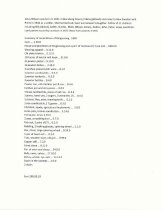
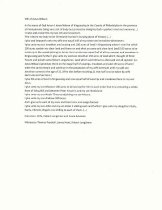
Jonas Nilsson's estate inventory & will |
Description |
Digital copy of a two-page typewritten transcript of the Jonas Nilsson's (father of Mouns Jones) estate inventory and will (abbreviated), c.1693. Of particular note is the will, in which Jonas leaves 230 acres of land to son Jonathan, 94 acres to son Jonas, 100 acres to Mouns, 70 acres to Nils, and 100 acres to Andrew. Jonas also bequeaths 1 shilling each to sons John and Peter, as well as daughters Gully, Gunla, Christin, and Brigett. This transcript illustrates the challenges presented in interpreting and charting the traditional patronymic naming system that the majority of Swedes used through the 17th and 18th centuries. Mouns Jones' patronymic "family" name, Jonasson, was derived from the fact that Magnus [the original Latin spelling, meaning "great" and the name assumed by several Swedish Kings] was Jonas's son. "Mouns" and other similar phonetic variations including Mans, Mounce, Monce, Mountz, etc., have been used by scriveners and writers for decades. One of Mouns' grandsons was called "Mounce" in various documents and records. Jonas' father's first name was Nils, thus Jonas' paternal family name was Nilsson, spelled three different ways in these transcripts. Recent genetic testing among members of the Lykens family in the male lineage indicates that descendants of Peter Lycan [Lycon and various other contemporary spellings], Mouns Jones' wife Ingeborg's father, are ethnically Finnish. Finns emigrated to Sweden in significant numbers, but, according to tradition, were less welcome as it became evident that they cut and burned trees faster than native Swedes thought prudent [see the discussion of the cultural and demographic tensions between the Swedes and the Finns in The Barbarous Years by Bernard Bailyn, Chapter 10, pp. 276 ff, particularly the analytical consideration of the Finns' "slash and burn" forestry and agricultural methods]. One of the ethnically Finnish Pennsylvania-Swedes, was Ingeborg's father Peter Lycon, who migrated to New Sweden with Swedes and Finns from the Kingdom of Sweden. The Jonasson clan Anglicized the family name to "Jones" late in the 17th or early in the 18th century. It appears as "Jones" in the Logan Ledgers in 1717 and the following ten years. The transcript does not reveal how Jonas signed his 1693 Will. In Section 19, Chapter III of Israel Acrelius' 1759 "Account of The Swedish Churches in New Sweden," Acrelius quotes a 1673 document executed by Governor Printz's daughter pertaining to a church bell from Tinicum Island. The document is witnessed by "Jonas Nilsson," who signed with a recumbent "X" as his mark. Laurence Ward, November 2016 |
Date |
2013 & c.1693 |
Object Name |
Transcript |
Catalog Number |
1000.01.117 |
Search Terms |
Estate Inventory Estate Records Finns Kingsessing MJTXT Mouns Jones Mouns Jones History Mouns Jones Text Philadelphia Swedish Settlement Swedish Settler Will |
Creator |
Naum, Magdalena |
People |
Eustason, Eusta Gunnarsson, Sven Hunt, James Jones, Anders Jones, Andrew Jones, Brigett Jones, Christin Jones, Gertrud Jones, Gully Jones, Gunilla Jones, John Jones, Jonas Jones, Jonathan Jones, Judith Jones, Mouns Jones, Nils Jones, Peter Longshore, Robert Naum, Magdalena Nilsson, Jonas Nilsson, Jonas Paschall, Thomas Yocum, Peter |
Notes |
Please note: This transcript was graciously provided by Magdalena Naum, PhD, of the Department of Archaeology & Ancient History at Lund Unversity in Lund, Sweden. Dr. Naum researched the original documents (and microfilms of those documents) at the archives located in City Hall in Philadelphia, PA. |