

Archive Record
Images
Additional Images [1]
Metadata
Collection |
Sites and Structures Reports |
Archive Number |
HPTSSR28 |
Title |
Sites and Structures Report, January 2020 |
Description |
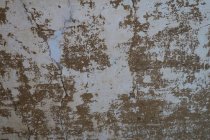
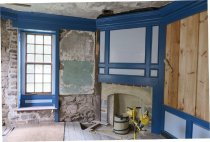
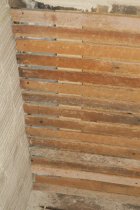
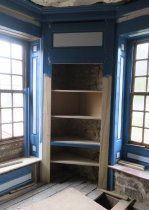
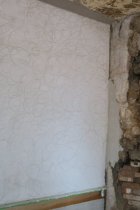
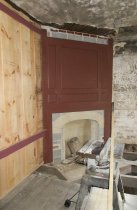
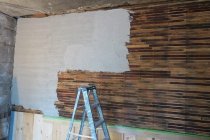
Sites & Structures Committee Report to the Board of Directors, January 7, 2020 George Douglass House Restoration Project, Summary of Work Accomplished October 1, 2019 to December 31, 2019: During this quarter substantial progress was achieved in first floor parlors, kitchen, and Amity Store room in the categories of interior plasterwork, joinery, and painting with precisely determined original colors: INTERIOR PLASTERWORK: For the entire project the primary preservation objective is to retain, stabilize, secure, and whitewash original plasters coatings soundly anchored in original hand-split lath and in a reasonably regular plane, and to re-plaster or re-coat only severely degraded, unstable, or otherwise un-salvageable early plaster. Reasonably intact original plaster will be preserved and exhibited un-coated. 1765 KITCHEN [SE QUADRANT]: Applied lath where necessary and repaired plaster on kitchen walls above and below chair-rail and above fireplace. Applied lath, scratch coat, brown coat to the re-created "bratticed" board partition above the chair rail [Photos ## 11//19/19, # 28 & 12/31/19, #9]. Removed lath and re-lathed deteriorated and detached or de-laminating ceiling plaster adjacent to the re-constructed partition; applied scratch and brown coats. Removed lath and applied re-purposed sawn lath to disturbed or compromised section of intersecting hallway wall adjacent to partition. c. 1768-c. 1798 AMITY STORE [SW QUADRANT]: (A) Missing plaster on the three original walls was replaced with a lime plaster "scratch" coat base, and a "brown" coat of lime plaster with an animal hair binder, keyed for a finish coat of lime plaster without additives. More extensive fractures were bridged with a base coat consolidated with a chemically neutral mesh tape and a finish coat. (B) A Structural steel column in the corner of the partition was bridged over with re-purposed sawn lath run into the corner joint with the hallway wall to provide lateral rigidity to the partition [Photo #2, 12/18/19]. All stabilized early plaster with discoloring surface accretions in the store will be gently brush-cleaned with water in preparation for lime-based whitewash in 2020. (C) The ceiling is severely compromised by many hairline and open cracks, thin covering over lath, and random detachment and deflection from the ceiling plane; the surviving plaster will be secured and re-aligned in the ceiling plane with recessed plaster washers, and re-coated, after application of mesh tape closure over re-filled open cracks. (D) All wallpaper remnants were removed from ceiling [Photo #2, 12/2/19]; adhesive residue to be reduced as much as feasible without abrasion or chemical cleaning agents or risk to the early plaster sub-strate. CARPENTRY AND JOINERY: Carpentry and joinery work in the 4th quarter focused on milling and fitting the fine paneling, cornice, and moldings preliminarily installed in the NW front ["best"] parlor in the 3d quarter, and preliminary installation of faithfully replicated joined woodwork in the family ["back"] parlor. Original segments of 1765 woodwork survive intact and in-situ in both parlors, providing three-dimensional templates for re-fabrication of replacement components. Each new element in the best parlor is fabricated and molded from an original fragment or complete module in its un-modified construction and molding profile. As determined to be the authentic original colors by consultant Matthew Mosca, Deep Prussian Blue and Moderate-Light Gray colors were applied to panel fields, stiles, rails, and molded architraves and panel transitions [Photos #4, 12/10/19, showing replicated wainscot and baseboard on best parlor partition; and Photo # 2, 10/28/19, showing paneling above the fireplace, molded cornice, and wainscot paneling]. Period panel fields in the best parlor were originally decorated with a medium-blue vernacular "marbleizing", some surviving, which will be studied, curated, and replicated by traditional techniques of the period. Photo #14, 12/14/19 shows the related fireplace paneling in the back parlor, and the aprons of the chair rail and cornice assembly, also painted in the photo-microscopically determined original "Spanish brown" color. Today, we began work with Tom & Chris Lainhoff in selecting early tongued & grooved boards donated by the Shelleys for the hall-parlor partition, replacement exterior doors, and 2d floor boards in the Mouns Jones House. The plan is to lay the flooring in a "blocked" pattern with joints aligned according to board lengths. Laurence Ward, Oct. 2020 |
Date |
January 2020 |
Object Name |
Report |
Catalog Number |
1008.01.069 |
Search Terms |
sites and structures reports SSR HPT |