

Archive Record
Images
Metadata
Collection |
Sites and Structures Reports |
Archive Number |
HPTSSR22 |
Title |
Sites and Structures Report, February 2014 |
Description |
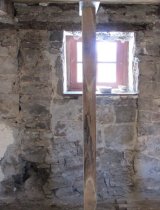
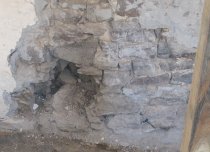
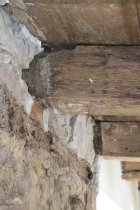
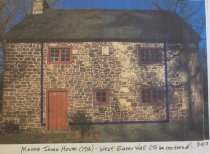
Sites & Structures Report, 2/12/14: DescriptionMouns Jones House Project: The recommended restoration work on the west eaves wall of the 1716 Mouns Jones house is based on two independent considerations: (I) the structurally unreliable segments of the wall, encompassing about 18 feet by 18 feet and extending from eaves level to foundation plinth as delineated on the attached Image #4, [blue-line photo, 9/18/15]. This deformed and structurally compromised condition presents an urgent mandate for the proposed reconstruction program; and (II) the out-of-period 19th-20th century doorway and fenestration arrangement, which should be restored during the stabilization campaign to its original 1716 symmetrical configuration according to clear evidence consisting of vertical joints [53" apart] in the surviving stonework [Image #1, photo 6863, Jan, 2014], and as documented by a HABS drawing published in the Trust's "Atlas". The evidence for this recommendation may be summarized as follows: (a)The extent of the bulge in the central bay and adjacent bay to its north is reliably gauged by an average separation of 2" between the cope-sawn floor board on the 2d floor and the concave interior wall surface. The swelling dislocation of the exterior plane of the wall is also obviously out-of-plumb and appears to be greater than 2" in deviation [the radial separation will be measured from a uniform vertical plane, and plotted]. This could indicate de-lamination in the wall core as well as integrated movement of the wall as a structurally unreliable radial "membrane". Plaster residue bands and oxidation disparities on the 2d-floor joists adjacent to the interior wall surface also support the inference that the wall has moved laterally since the 1965-1970 restoration campaign [Image #3, photo 7044, 2/1/14]. (b)A disintegrated cavity, 9" deep at its maximum penetration, near the brick-paved first floor is within the compromised wall area and straddles the lower portion of a vertical joint of the early doorway opening [Image #2, photo 6889, 1/30/14]. It was patched and plugged with Portland cement in the 1960s masonry restoration, but not properly consolidated with stone and traditional lime-mortar. (c)The distended wall ranges have moved the structural wall mass westward, out of vertical alignment with the foundation plinth supporting it. The rafter plates carrying the roof-load are not centered over the structural core of the foundation 20 ft. below. In this dislocated condition, the roof loads and thrusts are not securely "transmitted" in compression [statically neutralized and structurally stabilized] through the wall mass to the foundation. There is too much dependence on the pegged collar ties to hold the roof loads in place against the imposed lateral and oblique thrusts. (c)The average separation in the relatively stable north and south bays [outside the blue lines in the elevation photo, image #4] averages less than 1" and appears to be un-changed since 1970. This indicates that the walling deformation is probably confined to the central bay and the adjacent segments of the end bays, including the northern range penetrated by the 19th century doorway. It is hoped that the project can be safely limited to the wall areas defined by the apparent dislocations. Board approval is requested, subject to adequate grant funding, for proceeding with the project as described in detail in the documents to be submitted with the PHMC grant application. Respectfully submitted, Sites & Structures Committee; Updated, October, 2016 and November, 2020. Laurence Ward |
Date |
February 2014 |
Object Name |
REPORT |
Catalog Number |
1008.01.067 |
Search Terms |
HPTSSR sites and structures committee reports wall restoration doorway bulged wall displaced wall coped floor board roof load |