

Archive Record
Images
Metadata
Collection |
George Douglass |
Archive Number |
GDHRPT6 |
Title |
George Douglass House Restoration Report for the quarter ending June 30, 2019 |
Description |
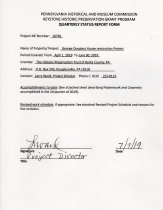
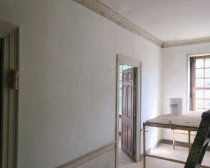
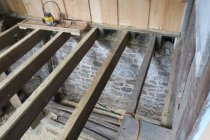
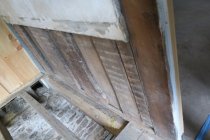
The Historic Preservation Trust of Berks County, PA., Project ME Number 16709 George Douglass House Project Work Accomplished April 1, 2019 to June 30, 2019 PLASTERWORK: During the 2d quarter of 2019, the project plasterer, William Smith of Brandywine Historic Services, made substantial progress in the interior work, completing urgent restoration of wall and ceiling integrity in the 2d floor chambers and hallway [Photo #12]. Preparation included removal of remaining later coatings and accretions of lime wash, paint, wallpaper adhesive, coal-soot, and soiling from original finish plaster that was sufficiently stable and well-anchored on the masonry wall substrate. Original 1765 plaster soundly anchored to the naturally-keyed exterior stone walling and with a reasonably regular plane, will remain un-coated. The only modification to the preserved original plaster surfaces will be spot-patching abraded and "cratered" blemishes with finish plaster tinted to match as closely as feasible the original off-white tone of the early plaster. The infill plaster will be feathered into the surrounding original surface, very lightly textured only by original trowel-tooling. A similar tint is still under consideration for a wash coating of the re-plastered partition wall surfaces. As established as the appropriate technique in the 1st quarter of 2019, unstable, de-laminated, and deflected plaster was restored to the proper ceiling-plane in the chambers with recessed washers where necessary. Missing plaster was infilled with a lime plaster base ["brown"] with a hair binder, and a "scratch" coat keyed for finish coating of lime plaster. Finish coatings were applied to the re-anchored and leveled ceilings in all chamber and hallway spaces on the 2d floor. Fractures were bridged with base and finish coatings after consolidating with a chemically neutral mesh tape. By the end of June, 2019, plaster restoration on the 2d floor, begun in the first quarter of the year, had progressed through all plaster walling and ceilings in the chambers and passage-hallway. Remaining detail work on the 2d floor will be completed in the 3d quarter of 2019 preserving original stable plaster and by stabilizing and re-coating compromised segments. CARPENTRY AND JOINERY: During the 2d quarter of 2019, the project carpenters concentrated on the shop-work and milling of floor boards necessary to achieve a level and solid floor composed of original boards in the best [front] parlor. Quarter-sawn oak boards of the same species and width-range as the originals will be used, if and only to the extent necessary to complete the floor. Severely-worn boards and erratic joist alignment required long shims of varying thicknesses to achieve an acceptably leveled restored flooring plane [photo # 28]. Flooring restoration in the best parlor will be completed in the 3d quarter of 2019. As a primary preservation objective, the same nail-holes in the floor boards and their counterparts in the joists will be used in nailing original boards to joists; later nail holes from re-flooring will be filled with wooden plugs. This process will be guided by board-location mapping recorded on a meticulous survey by the carpenters before lifting boards from joists. A set of 19th century oak boards, similar to the originals, will be installed in the back parlor in the third quarter. Re-created "wainscot" paneling [named for its similarity to board panels lining English crop-wagons ("wains")] will be applied to the original plank-work partition between the best parlor and hallway [photo # 29]. By the end of June, the lath, chair rail, and baseboard had been installed on the kitchen side of the new "bratticed" (alternating-plank) partition between the kitchen and the adjacent front room originally housing the "Amity Store" in the late 1760s [Photo #25]. This wall is now ready for re-plastering. See attached Revised Work Schedule for the sequence of future project work. HISTORIC PRESERVATION TRUST OF BERKS COUNTY-GEORGE DOUGLASS HOUSE RESTORATION REVISED WORK SCHEDULE-June 30, 2019 During the first half of 2019, it became apparent that the early plaster in 2d floor chambers and hallway was considerably more degraded and less securely anchored than anticipated. A similar and equally unexpected level of foot-wear, deterioration, and deformation appeared in the floor boards in the front ["best"] and back ["family"] parlors. These deficiencies required extraordinary measures and substantially more time for restoration and, in the front parlor, for re-use of original boards in their original locations. Based on these conditions, rather than "consolidating sound floor boards in the two northern parlors" as planned and set forth in the original project description, it was decided to: (a) consolidate, re-install, and restore to a level plane, the vast majority of original boards in the front ["best"] parlor, and (b) replace back parlor boards, most of which proved to be severely degraded, with available boards from a 19th century structure which are similar in width and oxidized patina to the originals. The following project history and circumstances explain the necessity for modifying the project sequence in both woodwork and plasterwork categories, and for seeking an extension of the time for completion. CARPENTRY AND JOINERY: Front (NW) parlor: The majority of the boards in the best parlor required substantially more shop-work and on-site carpentry and joinery to conserve, functionally restore, re-nail, and level in their authentic locations, as recorded in a survey and mapping of the flooring by the project carpenters prior to removal. This process will achieve the desired preservation objective of salvaging, effectively restoring, and re-placing the vast majority of the original quarter-sawn oak boards in their original locations, supplemented with the minimum number of old oak boards necessary to complete the floor. The final phase of nailing-in the restored original and replacement boards will be completed in the 3d quarter of 2019. Back (NE) parlor: Most of the original boards are too degraded, worn, or functionally compromised to continue in use without prohibitively time-consuming and expensive board-by-board "working" and consolidating. They will be replaced by available quarter-sawn oak boards of similar width to the originals and of a similar oxidized color and natural patina. Original boards will be preserved as historic artifacts and for possible conservation and use in a future restoration campaign. Other Woodwork: The lack of stable flooring also delayed the installation of "wainscot", over-mantle paneling, chair rail, baseboards, and other mouldings and mill-work in the two parlors. These wooden elements will be fabricated using surviving original components as templates, and must be installed before the plaster margins can be established, delaying the plaster restoration in significant segments of the wall ranges in the parlors and in the front store-room. The final margins of new plasterwork on the kitchen-store partition have been set by the new chair rail and baseboard applied between lath ranges on the kitchen plane of the wall. PLASTERWORK: The process described above has delayed the commencement of plasterwork scheduled for the two parlor spaces until the restored and replaced floor systems are fully installed. This phase of the flooring campaign will be completed in the coming months. The balance of woodwork restoration and replication in the parlors will be completed by the original or extended deadline for completion of the project. 2d floor plaster restoration: As a direct result of the above-mentioned conditions and delaying factors, plaster restoration and stabilization in the four 2d floor chambers and hallway, especially the ceilings, were considered urgent priorities. The testing process on the ceilings in all five spaces had determined that much of the plaster had deflected or partially de-laminated from the lath, or had become fractured, leaving separation between margins of larger cracks. Each chamber had experienced at least one collapse of an irregular slab of plaster onto the floor. The ceilings and some wall-ranges were stabilized by recessed plaster washers and mesh-tape where indicated. Plaster on chamber and hall walls was preserved in-place where substantially intact and well-anchored in lath or on the stone substrate of exterior walls. Later-period whitewash, paint layers, wallpaper and adhesive residue were removed and cracks repaired. Distressed plaster on walls has been restored, stabilized, and re-coated to utilize most efficiently the scaffolding erected in each space to provide a platform for the ceiling work. Stable and reasonably intact and well-anchored original wall plaster will be left un-coated, since there is no unequivocal evidence that the plaster surfaces were lime-washed or painted in the early period of the house. Blemishes and minor "craters" will be leveled to the wall-plane with finish plaster tinted to the ambient color tone of the original surface. Other than this detail work, plaster conservation and restoration on the 2d floor has been substantially completed as of June 30, 2019. Wall and ceiling integrity has been substantially restored in the chambers and upper hallway. The process, materials, and costs of this 2d floor plaster restoration campaign are reflected in the quarterly reports and Invoices submitted through the 2d quarter of 2019, with supporting photographs and other documentation for each period. Coved cornice restoration: A majority of the plaster remaining on the exterior coved cornice crowning the primary façade proved to be insufficiently anchored ["keyed"] in the concave lath profile. After repair or replacement of some of the original lath, the cornice had to be re-plastered from above the facade doorway to the southern terminus of the 1765 roof-line. The exterior cornice work, consisting of consolidation and anchorage of salvageable original plaster and re-plastering voids and degraded areas on the three elevations with coved cornices, will be completed during the 3d quarter of 2019. Project Completion: As the result of the scheduling challenges summarized above, it would be quite difficult to complete the project work, as now amended, by the initial September 30, 2019 deadline. As much of the remaining interior plasterwork and woodwork as possible will be substantially completed in the 3d quarter of 2019, including applying lath and plaster to the two new "blind’ partition walls between the two parlors and between the kitchen and the early store room. Provided that an extension of the time for completion is granted, the balance of the project work, including paneling, mouldings, and wainscot in the parlors, will be completed and funded during the extension period. Larry Ward |
Date |
July 2019 |
Object Name |
Report |
Catalog Number |
1006.01.052 |
Search Terms |
George Douglass George Douglass House GDHRPT Restoration coved cornice quarter-sawn oak masonry sub-strate ceiling plane wainscot panel bratticed Floor boards wall plane |
People |
George Douglass |